Contact

Machine Learning

Models are easy. Systems are hard.

A model in a notebook is a curiosity. A model in production, under load, accountable — that is engineering.

We ship the model, and the machine around it.

From experiment to infrastructure.

Most machine learning never leaves the lab. The gap is not the model — it is the pipeline, the monitoring, the drift, the data spine and the discipline to keep all of it honest.

We treat ML as a systems-engineering problem, and we ship the unglamorous parts that make the brilliant parts dependable.

Built from

3 capability lines behind 3 solutions

Each line is one of our divisions, the capabilities every system is assembled from. A link means the solution is built from that line.

Solutions for machine learning.3 named solutions, each shown in use below.

01/ 03PROVING GROUND

Production Pipelines & Drift

A model degrades quietly: the inputs move, the world moves, and nothing throws an error.

What it does

Training, deployment, monitoring and drift detection as one continuous system rather than a model handed over a wall. It watches for silent degradation and says so early.

Capabilities

  • Training, deployment, monitoring and drift as one system
  • Silent degradation detected and announced early
  • The difference between a model in production and one that used to work

In use
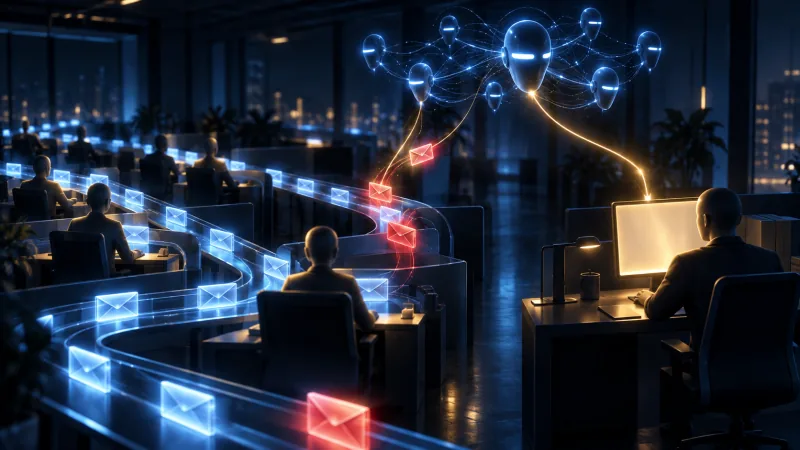
In a support office, glowing blue envelopes flow along lanes to staff at desks; a few red ones drift off course toward small glowing AI agents, which send a gold line to an engineer's screen.

In practice

EMAILS UNLIKE THE TRAINING DATA alert new product launches flagged within days, with examples three weeks beforelaunchtwo weeks after accuracy falls later, and nothing throws an error
An illustration of this story: the shape explains the idea, and no figure on it is a claim.

A model that routes customer emails has been accurate for a year. In March a new product launches, the emails start using words the model has never seen, and its accuracy falls quietly: nothing throws an error. PROVING GROUND watches the inputs as well as the outputs, sees them drift away from the training data within days, and flags it with examples. The team retrains before customers notice.

Built from
02/ 03ENSEMBLE

Model Orchestration

Composed carelessly, a system of models is less reliable than any of its parts.

What it does

Composition of models into systems that plan, call tools and act, with the routing, fallback and supervision that makes the whole more reliable than its parts. Each step is attributable.

Capabilities

  • Models composed into systems that plan, call tools and act
  • Routing, fallback and supervision around every step
  • Each step attributable when the output is wrong

In use

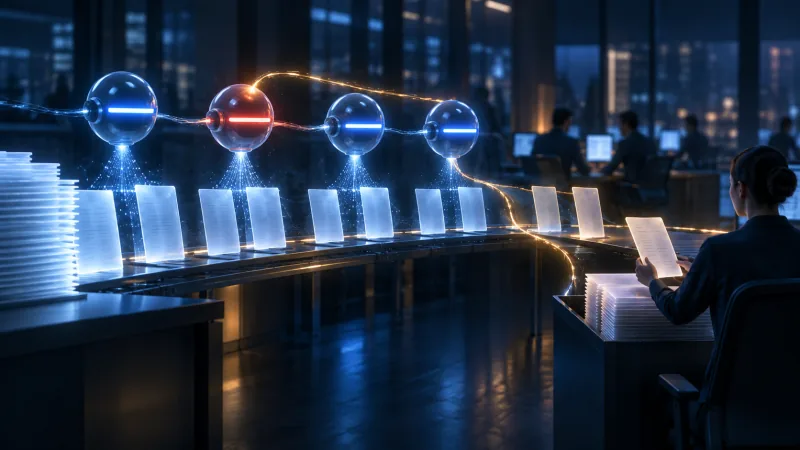
Glowing sheets pass beneath four small glowing AI agents in a row; the second glows red, and a gold line of light traces back to it and down to a claims handler reading a sheet.

In practice

A claims pipeline chains four models: read the document, extract the fields, check for fraud signals, draft the decision. When a decision comes out wrong, every step’s input and output are on the record, so the fault is traced to the extraction step, which read a day-first date as month-first. Documents the models are unsure of go to a person instead of being guessed at.

Built from

03/ 03GROUND TRUTH

Spatial & Sensor Data At Scale

A corpus without provenance is a corpus you cannot trust twice, and the metadata cannot be recovered afterwards.

What it does

High-fidelity spatial and sensor data captured, structured and labelled at training scale, with the capture conditions recorded alongside the measurements.

Capabilities

  • Spatial and sensor data captured and labelled at training scale
  • Capture conditions recorded alongside the measurements
  • Provenance kept, because it cannot be reconstructed later

In use

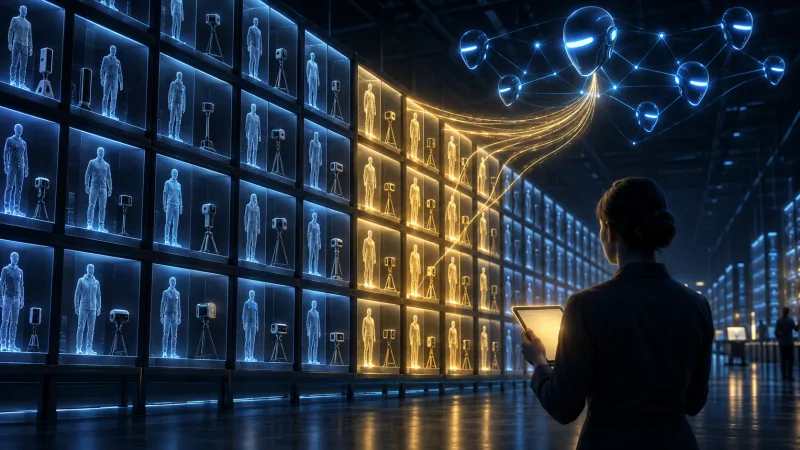
A researcher with a tablet faces a vast wall of glowing clothed figure scans, each shelved beside the scanner that captured it, as small glowing AI agents lift out one group in gold light.

In practice

Every scan in a body-scan corpus is stored with how it was captured: the device, the light, the distance and the consent. Two years later a model behaves differently on scans from one device; the corpus is split by device in one query, and the cause is found. Without metadata recorded at capture time, the question could not have been answered at any price.

By the numbers

3
named solutions
4
running systems behind them
3
capability lines applied
9
other industries sharing these systems

Counted from this site's own pages at build time. Nothing here is a claim.

Applied capabilities.

The divisions this industry draws on, and what they do here.

FORGE

Production ML pipelines

Training, deployment, monitoring and drift detection — the spine that keeps models honest in production.

ATLAS

Model orchestration

Composing models into agentic systems that plan, call tools and act under supervision.

VANTA

Spatial & sensor data

High-fidelity spatial and sensor data, captured and structured at training scale.

Put this to work in your operation.

Tell us what you are trying to achieve. We will tell you, honestly, what we can do.

Start a conversationAll industries

Analytics choices