Contact

Defence

Decision speed is the weapon.

In a contested environment, the advantage belongs to whoever closes the loop first — observe, decide, act — before the situation moves again.

Ahead of ready. Always.

The fog is the adversary.

Defence is the discipline of acting well on incomplete information, under pressure, against an opponent actively trying to make your information worse.

Our systems are built for the moment the network is degraded, the position is denied, and the operator needs one clear answer — now, traceable, and right.

How the nine work together

From readiness to recovery, under human command.

Each solution supports the people responsible at that stage, and every consequential decision is released by a person.

  1. Ready

    Vehicles, parts and access in order

  2. Supplied

    Loads that follow the roads as they are

  3. Protected

    Perimeters watched between patrols

  4. Deciding

    Options, position and a record that holds

  5. Recovering

    Infrastructure and communities back on their feet

Solutions for defence.9 named solutions, each shown in use below.

What happenedThe system actsA person acts or decidesThe outcome

01/ 09READYLINE

Fleet Readiness & Maintenance

Readiness is decided in the workshop, usually by whichever part is missing.

What it does

One board for a fleet’s real state, whether ready, waiting on a part or in the workshop, with fault reports from the vehicles and the workshop combined to forecast what will fail next. Parts are ordered ahead, workshop time is scheduled against the training and deployment calendar, and every order is approved by a person.

Capabilities

  • Every vehicle’s real state on one board
  • Faults combined to forecast what fails next
  • Parts ordered ahead, approved by a person
  • Workshop time scheduled against the calendar

In use

A fleet manager at dawn holds a tablet linked by a gold line to small glowing AI agents above a depot of vans and trucks, where one workshop bay glows red and a truck arrives.

In practice

  1. WednesdayWhat happened · 21 of 24 vehicles ready for Monday’s exercise
  2. WednesdayThe system · Fault reports forecast three cooling pumps failing within two weeks
  3. WednesdayA person · The fleet manager approves the orders and the workshop plan
  4. FridayThe system · Two pumps arrive from another depot and are fitted
  5. MondayThe outcome · 23 of 24 ready; the last has a date

A unit needs twenty-four vehicles ready for an exercise on Monday, and on Wednesday the board shows twenty-one. Fault reports point to three vehicles whose cooling pumps are likely to fail within two weeks; the agents draft the orders and a workshop plan, and the fleet manager approves them. Two pumps arrive from another depot on Thursday and are fitted on Friday. On Monday twenty-three vehicles are ready, and the twenty-fourth has a date.

02/ 09NEED TO KNOW

Coalition Access Control

Partners have to share quickly, and every share is also a decision about who may see it.

What it does

Access decided at the moment of the request, per person, role, nation and device, against the label each document and dataset carries. Every read is recorded, a lost device is locked out at once, and a section released to one partner stays closed to another until someone with the authority releases it.

Capabilities

  • Every document carries its own label and releasability
  • Access decided per person, role, nation and device, at the moment of the request
  • Every read recorded; a lost device locked out at once
  • Releases made by people with the authority to make them

In use

Three officers in a night-time briefing room each hold a tablet receiving its own gold line from small glowing AI agents above the table, where a lost tablet lies dark under a red padlock.

In practice

  1. 09:00The system · A shared plan labelled section by section
  2. 09:05What happened · Three people from three organisations request it
  3. 09:05The system · Each sees only the sections their role, nation and device allow
  4. 11:40A person · An officer reports a lost tablet
  5. 11:40The outcome · The tablet locked out at once; every read on the record

Today

Partners have to share quickly, and every share is also a decision about who may see it.

With NEED TO KNOW

09:00 → 11:40 · 2 h 40 min

A shared plan for a joint exercise has five sections. A liaison officer from one partner sees four of them; the fifth, marked for national eyes only, stays closed. A contractor sees only the logistics annex. When an officer reports a lost tablet, every session on it ends within seconds, and the record shows exactly what was read from it and when.

Built from

03/ 09RESUPPLY

Depot-to-Site Logistics

A supply plan is written for the roads as they were in the morning.

What it does

Resupply runs planned across depots and sites with every vehicle’s capacity, the drivers’ hours and the state of the roads. When a road closes or a site’s needs change, the runs re-solve and every site sees its new arrival time.

Capabilities

  • Runs planned with vehicle capacity, driver hours and road state
  • A closed road or a changed need re-solves the runs
  • Every site sees its own arrival time
  • Every load tracked from depot to signature

In use

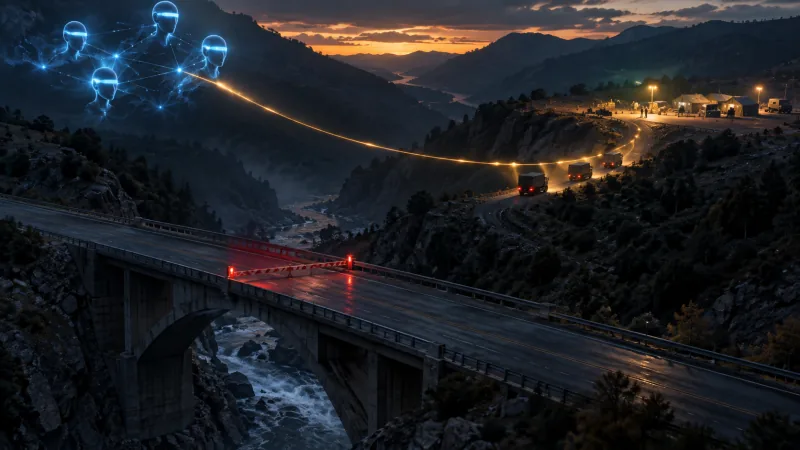
A red barrier closes a bridge in a valley at dusk as small glowing AI agents send a gold line along the far road to three supply trucks heading for a lit field camp.

In practice

  1. 06:30The system · Three resupply runs planned from the depot
  2. 07:40What happened · The main-road bridge closes; a site reports its water unit down
  3. 07:41The system · Runs re-solved: the valley road, and water loaded instead of fuel
  4. 07:45A person · The logistics officer confirms the new runs
  5. 11:50The outcome · All three loads signed for before noon

Today

A supply plan is written for the roads as they were in the morning.

With RESUPPLY

06:30 → 11:50 · 5 h 20 min

Three field sites are resupplied from one depot each morning. At 07:40 the bridge on the main road is closed for inspection, and one site reports that its water treatment unit is down. The runs re-solve: two vehicles take the valley road, and the third carries water instead of fuel. Every site sees its new time, and all three loads are signed for before noon.

04/ 09FENCELINE

Perimeter Patrol & Inspection

A perimeter is kilometres of fence, and people can walk it only so often.

What it does

A quadrupedal platform that patrols a programmed route around a site, covering fence, gates, culverts and lighting by day and night, compares what it sees with the previous patrol, and sends anything that has changed to the security operations centre. It reports; a person decides and responds.

Capabilities

  • A programmed patrol around the perimeter, day and night
  • Every patrol compared with the one before
  • Changes sent to the security operations centre with photographs
  • It reports; a person decides and responds

In use

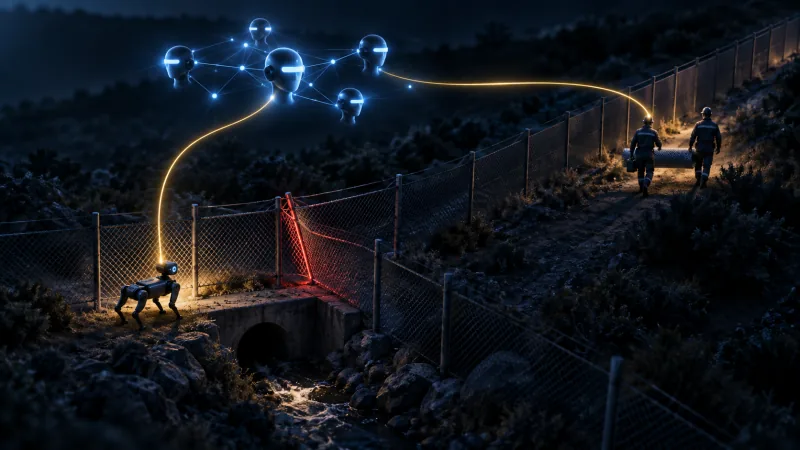
A four-legged inspection robot stands at a culvert where one fence section glows red. A gold line rises from it through small glowing AI agents to two repair workers carrying a roll of mesh.

In practice

  1. 02:00The system · The third patrol of the night begins
  2. 02:10What happened · A fence panel at the eastern culvert has moved since the last patrol
  3. 02:10The system · Photographs and position sent to the operations centre; the patrol continues
  4. 02:14A person · The duty sergeant reviews the images and sends a patrol
  5. 05:30The outcome · Storm damage found and made good before dawn

Today

A perimeter is kilometres of fence, and people can walk it only so often.

With FENCELINE

02:00 → 05:30 · 3 h 30 min

At 02:10, on its third patrol of the night, the platform reaches a culvert on the eastern fence and finds a panel displaced, leaving a gap that was not there two hours earlier. It sends the photographs and the position to the operations centre and carries on with its route. The duty sergeant reviews the images and sends a patrol, who find storm damage and make the fence good before dawn.

05/ 09NIGHTFALL

Decision Support Under Degraded Comms

The link degrades at the moment a decision is needed, and the reasoning stops with it.

What it does

Agents that draft options, surface the risk in each and rank them against stated intent, then stop. The release decision belongs to a person and is enforced at the authorisation layer. When the link degrades the reasoning continues locally and reconciles when it returns.

Capabilities

  • Options drafted, risk surfaced, ranked against stated intent
  • The release decision stays with a person, enforced at the authorisation layer
  • Reasoning continues locally through a degraded link
  • State reconciles when the link returns

In use

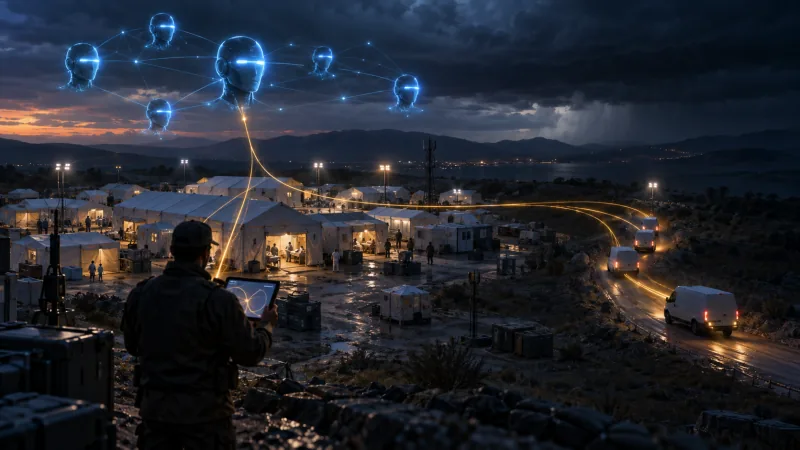
A commander seen from behind, tablet in hand, overlooks a tented field hospital at dusk as a storm rolls in. Small glowing AI agents send a gold line to white vans pulling onto the road.

In practice

  1. 18:00What happened · A decision is needed on moving a field hospital ahead of a storm
  2. 18:02The system · Agents draft three options and the risk in each, ranked against intent
  3. 18:05What happened · The link degrades; the reasoning continues locally
  4. 18:10A person · The commander releases one option; no agent can
  5. 18:30The outcome · The link returns and the records reconcile

Today

The link degrades at the moment a decision is needed, and the reasoning stops with it.

With NIGHTFALL

18:00 → 18:30 · 30 min

At 18:00 a decision is needed on moving a field hospital ahead of a storm, with one intent: patients safe before it peaks. The agents draft three options, to move tonight by the north road, move at first light, or stay and reinforce the shelters, and rank the risk in each against that intent. At 18:05 the link degrades; the reasoning carries on locally instead of stopping with it. At 18:10 the commander releases the first option. No agent can: the boundary is enforced at the authorisation layer, not requested in an instruction. When the link returns at 18:30, the records reconcile.

The principle

AGENTS draftproposeprepare authorisation layer THE WORLD movementsordersmessages THE COMMANDERapprove · release release proposal release
Agents draft and propose; only a person can release.

06/ 09BLINDSPOT

Denied-Environment Positioning

A confident wrong position is more dangerous here than an honest uncertain one.

What it does

Position held without satellites: inertial propagation, terrain reference and opportunistic signals fused into a single estimate that carries its own error bound and tells an operator how much to trust it.

Capabilities

  • Position held without satellites
  • Inertial propagation, terrain reference and opportunistic signals fused
  • Every estimate carries its own error bound

In use

A driver follows a valley road at dusk as signal waves fade at the cliffs. A gold ring fills the dashboard screen; small glowing AI agents send a gold line to a stone bridge.

In practice

  1. StartThe system · A vehicle’s position fused from satellites, inertial and terrain
  2. ValleyWhat happened · Satellite signals lost
  3. ValleyThe system · Position held on inertial; its error bound grows, and is shown
  4. BridgeThe system · A known landmark matched; the bound shrinks
  5. ExitThe outcome · The operator always knew how far to trust the position

A vehicle drives into a valley and loses its satellite signals. Its position is held on inertial, and the error bound grows, to about sixty metres, on the operator’s display instead of being hidden. At the bridge a known landmark is matched and the bound shrinks back to twelve. The operator always knows how far to trust the position. Here, a confident wrong answer is more dangerous than an honest uncertain one.

The principle

valley · no satellites true track honest estimate · error shown a confident wrong position landmark matched along the route
An honest error bound, shown as it grows, instead of a confident wrong position.

07/ 09CHAIN OF CUSTODY

Auditable Autonomy

Accountability is usually a report written afterwards, once the evidence has gone.

What it does

An append-only trail of every consequential action an autonomous system takes: what was proposed, what was known at the time, who released it and when. Accountability is a property of the architecture rather than a report generated later.

Capabilities

  • Every consequential action appended to a trail that cannot be edited
  • What was proposed, what was known, who released it and when
  • Built in from the first line rather than reconstructed

In use

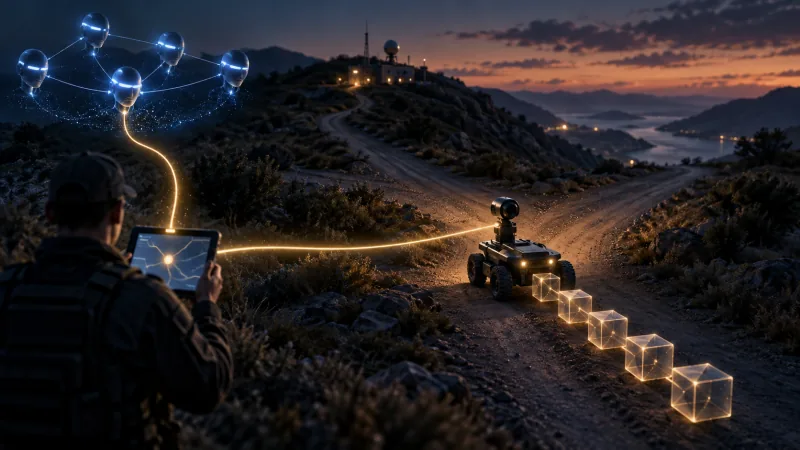
An officer's tablet relays a gold line from small glowing AI agents to an uncrewed vehicle at a fork in a track at dusk, trailed by a chain of glowing cubes like sealed records.

In practice

  1. ProposalThe system · An autonomous platform proposes an action
  2. RecordThe system · What was proposed and what was known, appended to the trail
  3. ReleaseA person · An authorised person releases it; the release is appended too
  4. LaterWhat happened · An attempt to edit an entry is refused
  5. ReviewThe outcome · Who knew what, and who released it, answered from the record

At 14:00 an uncrewed platform proposes to survey route B. The proposal goes onto a trail that cannot be edited, together with what the platform knew at that moment: wind at 14 knots, battery at 78 per cent. At 14:02 the duty officer releases it, and the release goes on the trail too. At 16:20 an attempt to edit the proposal is refused and recorded. When the review asks who knew what, and who released it, the answer comes from the record, not from a report written afterwards.

Built from

08/ 09FIRST LIGHT

Rapid Infrastructure Assessment

After a storm, an earthquake or any damage to an airfield, the first question is what still works, and it is usually answered on foot.

What it does

Runways, taxiways, bridges and port aprons captured from the air and the ground into a measured model at first light. Damage is mapped and sized, the usable strip or route is identified, and the repair list goes to the engineers who decide it.

Capabilities

  • Captured from the air and the ground at first light
  • Every point of damage mapped and sized
  • The usable strip or route identified
  • The repair list handed to the engineers who decide

In use

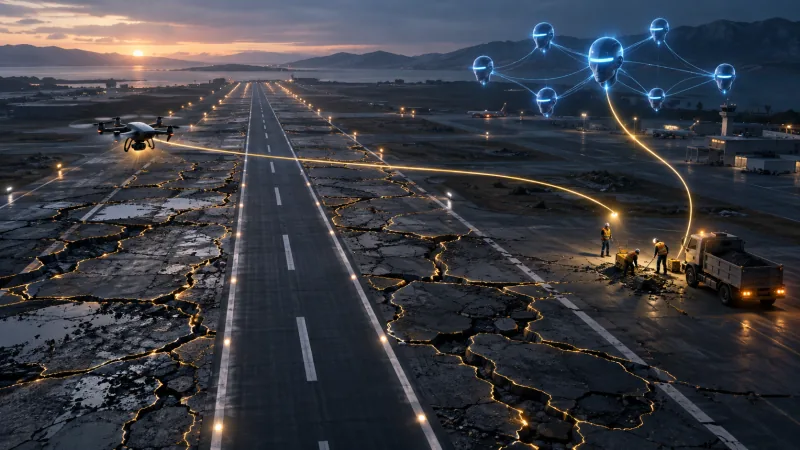
A drone at first light passes over a runway cracked by an earthquake, its one intact strip lined with lights; small glowing AI agents send a gold line of light to workers filling a hole.

In practice

  1. 05:40What happened · An overnight earthquake; the runway must be assessed
  2. 06:10The system · Two capture passes map and size every point of damage
  3. 06:40The system · A usable strip found, clear once two holes are filled
  4. 07:30A person · The engineers approve the repair list and quantities
  5. 11:45The outcome · The first relief aircraft lands

Today

After a storm, an earthquake or any damage to an airfield, the first question is what still works, and it is usually answered on foot.

With FIRST LIGHT

05:40 → 11:45 · 6 h 5 min

After an overnight earthquake, an airfield’s runway has to be assessed before relief flights can land. Two capture passes at first light map eleven points of damage and size each one. The model shows a strip of 1,500 by 23 metres that is clear once two holes are filled, and the engineers have the repair list, with quantities, by 07:30. The first relief aircraft lands before noon.

09/ 09HOMEFRONT

Support to Civil Authorities

When a flood or a fire outruns the civil services, the armed forces arrive with vehicles and people, but not with the list of who needs what.

What it does

The civil authority’s requests, from shelters, hospitals and care homes, matched to the vehicles, crews and engineering teams sent to help, with each task tracked until it is closed. Residents are reached by message in their own language, and the authority sees what has been done without asking.

Capabilities

  • Civil requests matched to vehicles, crews and engineers
  • Every task tracked until it is closed
  • Residents reached by message in their own language
  • The civil authority sees progress without asking

In use

Three covered trucks seen from behind follow a gold line of light up through a flooding riverside town at night to a lit care home on the hill, where small figures wait outside.

In practice

  1. 18:00What happened · A flood forecast; the civil authority asks for help
  2. 18:05The system · Requests matched to trucks, engineers and a water bowser
  3. 18:10The system · Residents in the flood zone messaged in their own language
  4. 18:15A person · The liaison officer confirms the tasking with the authority
  5. 23:50The outcome · The care home evacuated, the station protected, every task closed

Today

When a flood or a fire outruns the civil services, the armed forces arrive with vehicles and people, but not with the list of who needs what.

With HOMEFRONT

18:00 → 23:50 · 5 h 50 min

A river is forecast to break its banks overnight. The civil authority asks for help with a care home of thirty-two residents, sandbags for a pumping station and water for a shelter. The requests are matched to two high-clearance trucks, an engineer section and a water bowser, and residents in the flood zone get a message in their language telling them where to go. By midnight the care home is evacuated, the pumping station is protected and every task is closed on the authority’s board.

By the numbers

9
named solutions
9
running systems behind them
6
capability lines applied
9
other industries sharing these systems

Counted from this site's own pages at build time. Nothing here is a claim.

Applied capabilities.

The divisions this industry draws on, and what they do here.

ATLAS

Agentic decision support

Multi-agent reasoning that drafts options and surfaces risk — under human command, with every step on the record.

MERIDIAN

Positioning in denied conditions

Reliable location and movement intelligence engineered for GPS-denied and contested operation.

ROBOTRONIX

Uncrewed platform autonomy

Guidance and control for unmanned systems that keep working when the link to home goes dark.

CONCORD

Allocation & Matching

Real-time matching and dispatch. Pairing supply with demand across constraints that move faster than a human dispatcher can hold in their head.

AEGIS

Trust, Access & Audit Fabric

Row-level authorisation, multi-factor authentication, device approval, tiered access and an append-only audit trail. The sign-in on this site is the product.

VANTA

Spatial Capture & Reconstruction

LiDAR and photogrammetric capture on commodity hardware, reconstructed into measurable, navigable models — not decorative point clouds.

Put this to work in your operation.

Tell us what you are trying to achieve. We will tell you, honestly, what we can do.

Start a conversationAll industries

Analytics choices