
Contact

Tourism

Move millions of people, gracefully.

Tourism is a vast, distributed optimisation problem dressed as a holiday.

We make the largest journeys feel personal.

Scale without strain.

Destinations, transport, demand, weather, seasonality — tourism is a system that strains at its seams every peak and slackens every off-season.

We model the whole flow and optimise it continuously, so capacity meets demand and the experience holds — whether it is a quiet Tuesday or the busiest weekend of the year.

How the nine work together

A trip, seen from the destination’s side.

Each solution acts at the moment it is needed, from the weeks before the season to the day something goes wrong.

  1. Before the season

    Demand forecast early, routes measured

  2. Planning the trip

    An itinerary held as intent

  3. Getting there

    Connections guarded, arrivals staggered

  4. At the destination

    Flow, entry and transport kept in balance

  5. When it goes wrong

    Everyone located, told and moved

Solutions for tourism.9 named solutions, each shown in use below.

What happenedThe system actsA person acts or decidesThe outcome

01/ 09HIGH SEASON

Demand Forecasting & Pricing

Rates and capacity are set weeks ahead from last year’s calendar, while the signals that decide this weekend arrive by the hour.

What it does

A demand model that reads the signals arriving by the hour: flights and ferries booked into the area, the pace of bookings, rates and availability across the area, road traffic, events and what people are saying online. It forecasts demand night by night, recommends rates and capacity to the revenue manager, who approves them, and shows which signals moved each recommendation.

Capabilities

  • Live signals read together: flights, ferries, booking pace, area rates and availability, traffic, events, online mentions
  • Demand forecast night by night, with its uncertainty shown
  • Rate and capacity recommendations, each with the signals behind it
  • Nothing changes until the revenue manager approves it

In use

A hotel manager holds a tablet above a night harbour as a ship, an aircraft and the coast road send blue streams into small glowing AI agents, whose gold line of light reaches the hotel.

In practice

  1. Tue 09:00What happened · A festival announced for Saturday; ferry and flight bookings to the island start to climb
  2. Tue 15:00The system · Area rates, availability, traffic and online mentions read with them: Saturday forecast to sell out
  3. Wed 09:00The system · Recommended: Saturday from €180 to €230, with the signals behind it
  4. Wed 11:20A person · The revenue manager approves the new rate
  5. SaturdayThe outcome · Sold out at €230: in this illustration, 28 % more room revenue that night

An illustration. On a Tuesday in June a music festival is announced for the coming Saturday. Within hours the model sees ferry and flight bookings to the island climb, online mentions of the festival spike, traffic toward the port rise, and the island’s other hotels fill faster than usual while their average rate starts to move. By the afternoon it forecasts that Saturday will sell out, days before last year’s calendar would have shown it. On Wednesday morning it recommends raising the 80-room hotel’s Saturday rate from €180 to €230, and shows the signals behind the recommendation. The revenue manager approves it at 11:20. Saturday still sells out, at the new rate: in this illustration, 28 % more room revenue that night, €18,400 instead of €14,400.

Built from

02/ 09STEP-FREE

Accessible Route Capture

Old towns are mapped as if everyone can climb steps, and the step-free route exists but nobody has measured it.

What it does

A capture service that measures the streets and sites a visitor actually uses — steps, kerbs, gradients, surfaces — and computes step-free routes from those measurements rather than assuming them. The routes feed the itinerary agent and the entry desk, so an accessible plan is a verified one.

Capabilities

  • Steps, kerbs, gradients and surfaces captured to measurements
  • Step-free routes computed from the measurements, not assumed
  • Routes shared with the itinerary agent and the entry desk
  • Re-captured when a street changes

In use

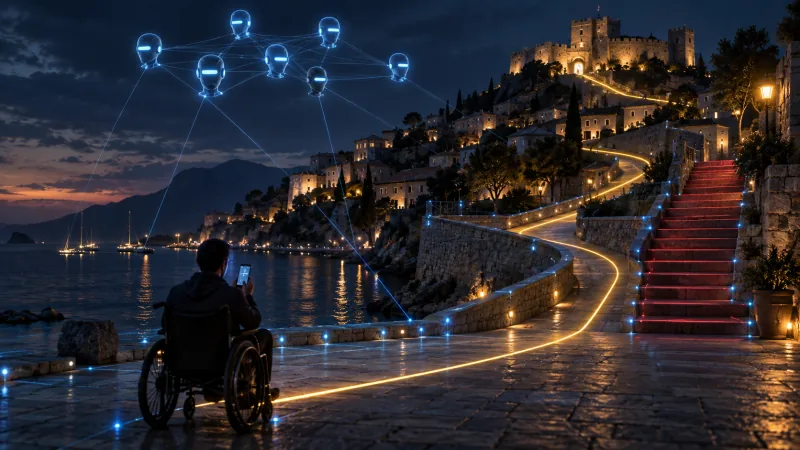
A wheelchair user on a quay holds a phone as small glowing AI agents measure the steps; steep stairs glow red while a gold line winds from the wheelchair up a ramp to the castle.

In practice

  1. SurveyThe system · The old town captured: steps, kerbs, gradients, surfaces
  2. RequestA person · A wheelchair user asks for a route from the harbour to the castle
  3. RouteThe system · The shortest line rejected: three flights of steps
  4. RouteThe system · A step-free route found: 420 m, never steeper than 5 %
  5. TripThe outcome · The itinerary carries a measured route, not a promise

A wheelchair user wants to reach the castle from the harbour. The shortest line climbs three flights of steps. The captured model knows where every step, kerb and steep lane is, and returns a route that is longer — four hundred and twenty metres — but never steeper than five per cent and never interrupted by a step. It reaches the itinerary as a route that has been measured, not a promise.

03/ 09WAYFINDER

Agentic Itinerary Operations

A traveller’s requests arrive all at once, and every one of them depends on the weather, a supplier or someone’s say-so.

What it does

An agent that holds a traveller’s plans as intent rather than a fixed schedule. It takes every request, books what it can against live availability and the forecast, asks the right person for what it cannot grant, and keeps one itinerary current in the traveller’s own language.

Capabilities

  • Every request taken, however many arrive at once
  • Booked against live availability and the forecast
  • What it cannot grant asked of the right person
  • One itinerary kept current, in the traveller’s own language

In use

A traveller on a villa terrace at dusk holds up a phone, sending blue threads to small glowing AI agents, whose gold lines reach a private boat at the quay and a lit seaside restaurant.

In practice

  1. Sun 18:00A person · A traveller sends six requests: a boat, a table, a cake, a photographer, a ferry change and a museum visit
  2. Sun 18:02The system · Forecast read: wind after 13:00, so the boat is booked for the morning
  3. Sun 18:10The system · Table at 21:30, the cake sent there, a photographer at sunset, the ferry moved to 16:00
  4. Mon 10:15A person · The museum’s events office offers a private visit at 18:00 on Thursday
  5. Mon 10:20The outcome · Six requests, all resolved, in one itinerary the traveller agreed to

On Sunday at 18:00 a traveller with a party of eight sends six requests in a row: a private boat tomorrow, a table at the island’s busiest seafood taverna, a gluten-free birthday cake, a photographer at sunset, their Friday ferry moved to the afternoon, and a visit to the museum after hours. The agent reads the forecast first: wind force 7 after 13:00, so the boat is booked for the morning, with a licensed skipper. The taverna is full at 21:00, so it takes 21:30 on the terrace and has the cake delivered there. The photographer is booked at the castle for sunset, and the ferry moved to 16:00 with the transfer moved to match. The museum visit is not the agent’s to grant, so it asks the museum’s events office, which offers a private visit at 18:00 on Thursday, and the traveller accepts. Six requests, all resolved, in one thread and in their own language.

04/ 09CROSSING

Ferry & Connection Guard

One cancelled sailing breaks every connection behind it, and the traveller finds out on the quay.

What it does

A guard on every traveller’s chain of legs — transfer, ferry, transfer, hotel, flight. When a sailing is banned or runs late, it re-plans the chain end to end, moving the transfer, holding the room and protecting the flight, and tells the traveller in the thread they already have.

Capabilities

  • Every leg of a journey watched as one chain
  • A banned or late sailing re-plans everything behind it
  • Transfers moved and rooms held before the traveller asks
  • The traveller told in the thread they already have

In use

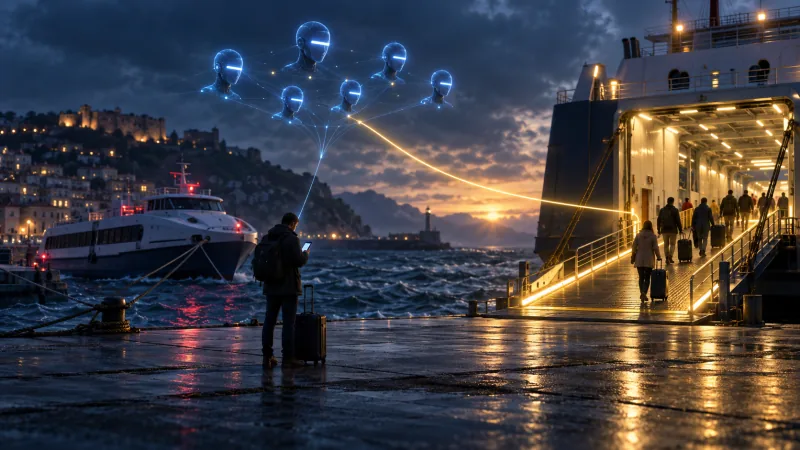
At a windy harbour, a traveller with a suitcase reads a phone near a fast ferry lit red, as small glowing AI agents send a gold line to a large ferry where travellers walk aboard.

In practice

  1. 07:00What happened · Sailing ban for fast ferries: wind force 8
  2. 07:01The system · The 10:30 catamaran will not sail; the 14:00 ferry will
  3. 07:02The system · Transfer moved to 12:15; the next hotel told of a late arrival
  4. 07:03The system · The evening flight checked and still made
  5. 07:30The outcome · The traveller wakes to one message with the whole new plan

Today

One cancelled sailing breaks every connection behind it, and the traveller finds out on the quay.

With CROSSING

07:00 → 07:30 · 30 min

At seven in the morning the port authority bans small fast ferries for the day: the wind is at force 8. The 10:30 catamaran will not sail; a larger ferry at 14:00 will. The traveller’s morning transfer is moved to meet it, the next hotel is told to expect a late check-in, and the evening flight is checked and still made. The traveller wakes to one message with the new plan, not to a closed ticket office.

05/ 09SHORE LEAVE

Cruise-Day Orchestration

A cruise call lands thousands of people on a small island inside the same hour, and the queue for the tender eats the day.

What it does

An orchestration engine for a port day. It takes the berth schedule and each ship’s shore-excursion plan, and staggers tenders, coaches and guides so arrivals at the busiest sites spread across the hours instead of landing at once. It re-solves when a ship runs late or tendering is suspended.

Capabilities

  • Berth schedule and excursion plans solved as one day
  • Tenders, coaches and guides staggered against site capacity
  • Re-solved when a ship runs late or the sea closes tendering
  • The destination sees the whole day before it starts

In use

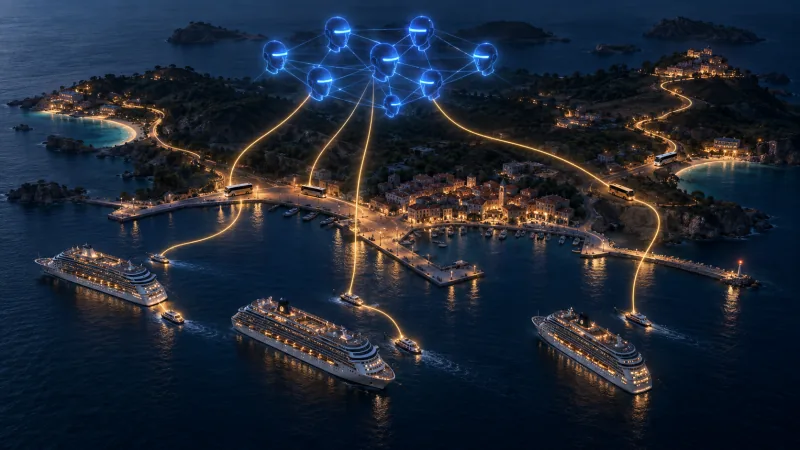
Three cruise ships lie off an island port; small glowing AI agents above the harbour send gold lines to tender boats and coaches heading to far beaches and villages, while the old town stays quiet.

In practice

  1. 06:30What happened · Three ships due with 7,300 guests between 07:00 and 10:00
  2. 06:31The system · Left alone, the old town would be over capacity by 09:30
  3. 06:33The system · Tenders and coaches staggered; one ship sent to the far side first
  4. 09:50What happened · Ship C reports forty minutes late
  5. 09:51The outcome · The afternoon re-solves; the old town stays under capacity all day

Today

A cruise call lands thousands of people on a small island inside the same hour, and the queue for the tender eats the day.

With SHORE LEAVE

06:30 → 09:51 · 3 h 21 min

Three ships are due. Left alone, most of their guests would reach the old town between half past eight and half past nine, and the square would be over capacity before ten. The plan staggers the tenders and the coach departures, sends one ship’s excursions to the far side of the island first, and spreads arrivals across the morning. When the third ship reports forty minutes late, the afternoon re-solves around it rather than stacking it on top of the lunch peak.

06/ 09CURRENTS

Visitor Movement Intelligence

A resort’s public spaces are laid out once, while guests decide every day where they actually want to be.

What it does

Movement analytics for a resort’s public spaces. The cameras already in place are read on site and turned into anonymous counts per zone, never faces or identities, so the team sees where guests gather, when and for how long, and can change the space to match.

Capabilities

  • Existing cameras read on site; only anonymous counts leave them
  • Occupancy and time spent per zone, hour by hour
  • Patterns across days turned into specific changes
  • No face recognised, no guest identified, no individual track kept

In use

A resort pool terrace from above, guests shown as tiny anonymous gold figures clustered under a few parasols. A pole camera feeds small glowing AI agents, whose gold lines reach staff opening more parasols.

In practice

  1. Week 1The system · Lobby, breakfast room, pool and terrace counted as anonymous zones, hour by hour
  2. Week 2What happened · Patterns: breakfast queues at 08:30, shaded loungers full by 10:00, the terrace full after 21:00
  3. Week 2A person · The operations manager reviews the patterns and chooses three changes
  4. Week 3The system · The same zones counted again, so every change can be checked
  5. Week 3The outcome · No breakfast queue, the loungers used, the terrace busy, and no guest identified

A resort wants to know how guests actually use its public spaces. The cameras already in place are read on site and turned into anonymous counts per zone (lobby, breakfast room, pool and terrace) hour by hour; no face is recognised, no guest identified and no individual track kept. After two weeks the patterns are plain: the breakfast queue peaks at 08:30, the shaded loungers are full by 10:00 while the sunny ones stand empty, and the terrace overflows after 21:00 while the lobby bar is quiet. The operations manager chooses three changes: a second breakfast counter from 08:15, shade over twelve more loungers, and the evening music moved to the terrace. The following weeks are counted the same way, and each change shows in the counts.

Built from

07/ 09TIMESLOT

Timed Entry from Live Conditions

Entry slots are sold weeks ahead, but they do not know about today’s heat, today’s queue or today’s ships.

What it does

A capacity desk for timed entry. It holds each slot’s capacity against live conditions — the queue at the gate, the heat, the ships in port — and when a closure is declared it moves the affected visitors into slots that are still open and tells them before they set out.

Capabilities

  • Slot capacity held against the gate, the heat and the ships in port
  • A declared closure moves affected visitors into open slots
  • Every moved visitor told before they set out
  • No slot sold past what the site can hold

In use

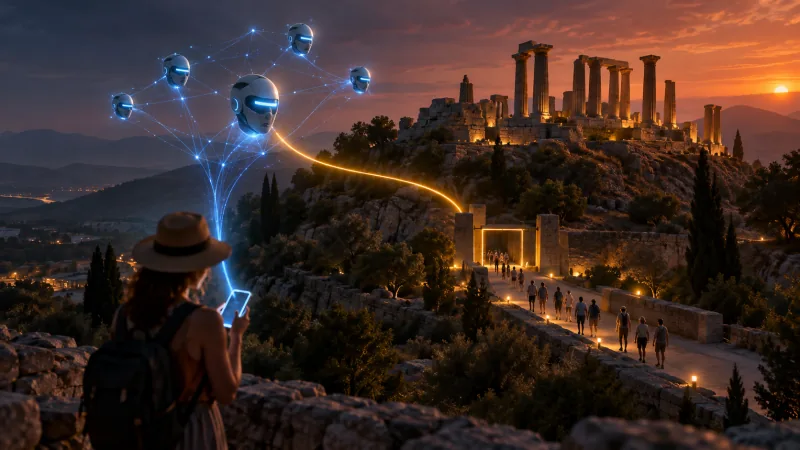
A visitor accepts a new time on her phone beneath small glowing AI agents, which send a gold line of light to a hilltop ruin's gate, where people enter in evenly spaced groups.

In practice

  1. 07:00What happened · Heat advisory: the site closes 13:00–17:00
  2. 07:01The system · Visitors holding the four midday hours identified
  3. 07:02The system · Each offered the nearest open slot, morning or evening
  4. 07:05A person · Visitors accept in one reply; tickets rewritten
  5. 13:00The outcome · Nobody arrives at a closed gate; no slot over its limit

Today

Entry slots are sold weeks ahead, but they do not know about today’s heat, today’s queue or today’s ships.

With TIMESLOT

07:00 → 13:00 · 6 h

A heat advisory closes the site from one until five in the afternoon. About three hundred visitors hold tickets for those four hours. Instead of a closed gate and a crowd outside it, each of them is offered the nearest open slot that morning or evening, in their own language, and the move is written to their ticket the moment they accept. The morning slots fill to their limit and no further.

08/ 09ISLAND LOOP

Demand-Responsive Island Transport

A fixed island bus runs empty at ten in the morning and leaves people behind at sunset.

What it does

An on-demand transport engine for an island. Requests from visitors and residents are pooled into shared rides with virtual stops, and the shuttle’s route is re-formed continuously as new requests arrive — the same allocation engine that runs transfers, applied to a whole island.

Capabilities

  • Requests pooled into shared rides
  • Virtual stops where people actually are
  • Routes re-formed continuously as requests arrive
  • Residents and visitors on the same service

In use

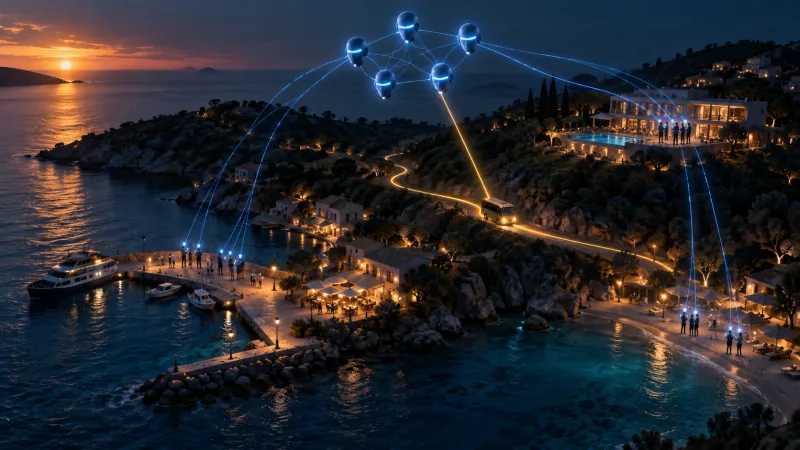
An island at dusk: groups at the harbour, a hillside hotel and the beach hold phones linked to small glowing AI agents, which send a gold line to one shuttle on the coast road.

In practice

  1. 19:10What happened · Requests for the west coast rise ahead of sunset
  2. 19:11The system · Requests pooled into shared rides
  3. 19:12The system · Virtual stops set a short walk from each request
  4. 19:14The system · The route re-forms as three more requests arrive
  5. 19:40The outcome · Everyone at the coast for sunset; no empty loops in the morning

Today

A fixed island bus runs empty at ten in the morning and leaves people behind at sunset.

With ISLAND LOOP

19:10 → 19:40 · 30 min

At sunset everyone wants to reach the west coast at once. Instead of one timetabled bus that is full at the first stop, requests are pooled: a couple at the harbour, three guests at a hillside hotel, a family on the beach road, each met at a virtual stop a short walk away. The shuttle’s route re-forms with every new request, and in the quiet morning hours no vehicle drives an empty loop.

09/ 09MUSTER

Crisis & Evacuation Coordination

In a wildfire or a storm, nobody holds one list of who is where, so people are found by phone calls and moved by guesswork.

What it does

A coordination layer for the day everything has to move at once. It holds one live roster of every guest, hotel and vehicle, messages every affected traveller in their own language, allocates vehicles to the hotels inside the zone and routes them to muster points. The incident team releases every order, and every decision is recorded as it is made.

Capabilities

  • One live roster of guests, hotels and vehicles
  • Every affected traveller messaged in their own language
  • Vehicles allocated to hotels in the zone and routed to muster points
  • The incident team releases every order; every decision is recorded

In use

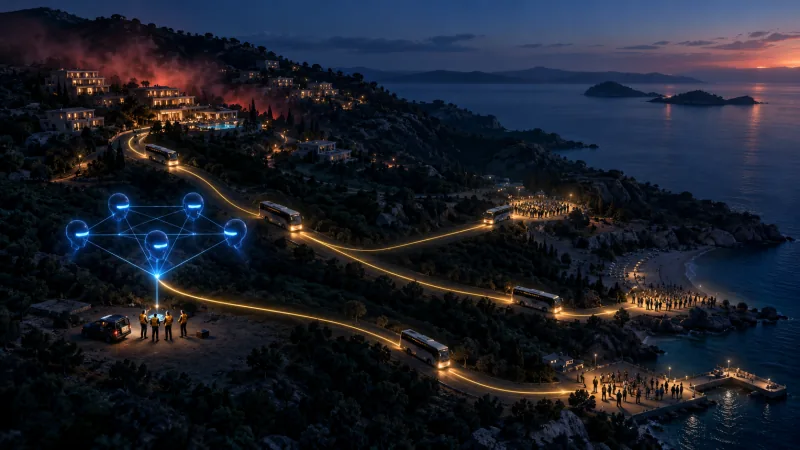
An island seen from above: a red haze hangs over hillside hotels while an incident team stands under small glowing AI agents, whose gold lines guide coaches out to three gathering points where guests wait.

In practice

  1. 14:10What happened · Hazard zone declared across the west of the island
  2. 14:11The system · Guests in the five hotels inside the zone located
  3. 14:13The system · Vehicles allocated to hotels, routed to three muster points
  4. 14:14A person · The incident team releases the plan
  5. 14:15The outcome · Every guest messaged in their language; pickups under way

Today

In a wildfire or a storm, nobody holds one list of who is where, so people are found by phone calls and moved by guesswork.

With MUSTER

14:10 → 14:15 · 5 min

A hazard zone is declared across the west of the island. Five hotels sit inside it. Within minutes the incident team sees how many guests each one holds, which vehicles are nearest, and a proposed allocation to the three muster points outside the zone. They release it. Every guest receives the instruction in their own language, drivers receive their pickups, and the board shows who has been collected and who is still waiting — for the people running the response, not reconstructed afterwards.

By the numbers

9
named solutions
8
running systems behind them
5
capability lines applied
9
other industries sharing these systems

Counted from this site's own pages at build time. Nothing here is a claim.

Applied capabilities.

The divisions this industry draws on, and what they do here.

CONCORD

Demand & capacity matching

Continuous optimisation of capacity against demand at destination and regional scale.

MERIDIAN

Movement intelligence

Understand how visitors move across a region in real time — and route capacity to meet them.

ATLAS

Agentic planning

Dynamic, agent-built itineraries and operations that adapt as conditions and demand shift.

VANTA

Spatial Capture & Reconstruction

LiDAR and photogrammetric capture on commodity hardware, reconstructed into measurable, navigable models — not decorative point clouds.

AEGIS

Trust, Access & Audit Fabric

Row-level authorisation, multi-factor authentication, device approval, tiered access and an append-only audit trail. The sign-in on this site is the product.

Put this to work in your operation.

Tell us what you are trying to achieve. We will tell you, honestly, what we can do.

Start a conversationAll industries

Analytics choices