Contact

Healthcare

Precision, where it counts the most.

Healthcare is the domain where a better decision is measured in lives.

Technology that earns the right to be in the room.

No margin for the approximate.

Care is a coordination problem of extraordinary stakes — people, equipment, time and information, all needing to be in the right place at the right moment.

We bring spatial precision and agentic coordination to clinical and operational settings, with auditability and data sovereignty built in from the first line of code.

How the ten work together

A patient’s path, from the first call to the years after.

Each solution acts at the moment the path needs it. Clinical decisions stay with clinicians at every stage.

  1. First contact

    Every call answered, and care planned from abroad

  2. The consultation

    The note written for the clinician, the choice shown to the patient

  3. Measured in 3D

    Skin and body measured, supports made to fit

  4. The clinical cycle

    Drafted by AI and signed by the physician; studies found in the clinic’s own records

  5. Between visits

    The years as one record, and the patient decides who sees it

Solutions for healthcare.10 named solutions, each shown in use below.

What happenedThe system actsA person acts or decidesThe outcome

01/ 10FRONT DESK

Clinic Operations Platform

A clinic’s front desk runs on a calendar, a phone and a spreadsheet, and every missed call is a patient who books somewhere else.

What it does

An operations platform for multi-clinic medical and aesthetic groups. Every doctor’s calendar in one view, one record per patient, online booking with deposits, an AI receptionist on the phone and on WhatsApp in the patient’s own language, treatment charting, memberships, stock traced from lot to patient, and e-invoices issued as each payment is taken.

Capabilities

  • Every clinic, doctor and room in one calendar, rescheduled by drag
  • An AI receptionist on the phone and WhatsApp, handing to staff with the whole thread
  • Online booking with deposits, reminders and no-show rules
  • Charting, memberships, stock traced lot to patient, and e-invoices at the point of payment

In use
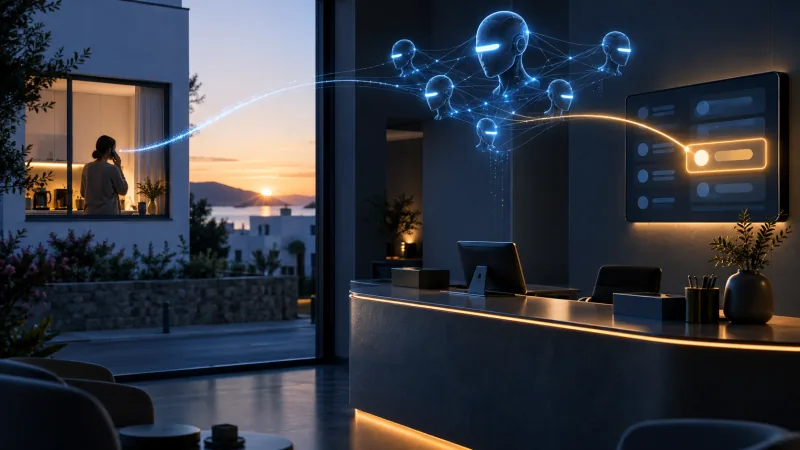
In an empty clinic reception at dawn, small glowing AI agents reach through the window to a woman phoning from a kitchen opposite, and a gold line lights one booking on a wall screen.

In practice

  1. 08:05The system · Overnight, the AI receptionist booked two consultations and held one question for a doctor
  2. 09:40What happened · A doctor is called away with six patients still to see
  3. 09:41The system · Each patient offered the nearest slot with a colleague or at another clinic
  4. 09:45A person · The front desk approves the moves; every patient confirms in one reply
  5. 20:00The outcome · Every visit charted, the stock traced to each patient, every payment invoiced

Today

A clinic’s front desk runs on a calendar, a phone and a spreadsheet, and every missed call is a patient who books somewhere else.

With FRONT DESK

08:05 → 20:00 · 11 h 55 min

At 08:05 the front desk of a three-clinic group opens the day. Overnight, the AI receptionist answered a missed call and three WhatsApp messages in the patients’ own languages, booked two consultations with deposits and held one question for a doctor. At 09:40 a doctor is called away with six patients still to see. The calendar offers each of them the nearest slot with a colleague or at the clinic across town, the front desk approves the moves, and every patient confirms in one reply. By evening every visit is charted, the stock used is traced to the patient who received it, and every payment has left as an e-invoice.

02/ 10COUNTERSIGN

Clinical Command Center

A longevity report takes a physician hours to assemble from new results, old reports and consultation notes, and a number copied by hand can be copied wrong.

What it does

A command center for longevity and preventive-medicine clinics. New results, the physician’s notes and the previous report go in; an AI drafts the new report and programme, with every figure drawn only from verified results. The physician edits and signs it, and only then does it reach the patient’s app, the PDF and the calendar.

Capabilities

  • Results entered or uploaded, and verified row by row before anything uses them
  • An AI draft of the report and programme, every figure traced to a verified result
  • The physician edits, signs and publishes; nothing reaches the patient unsigned
  • Calendar, messages, finance and a full log for every clinic in the group

In use

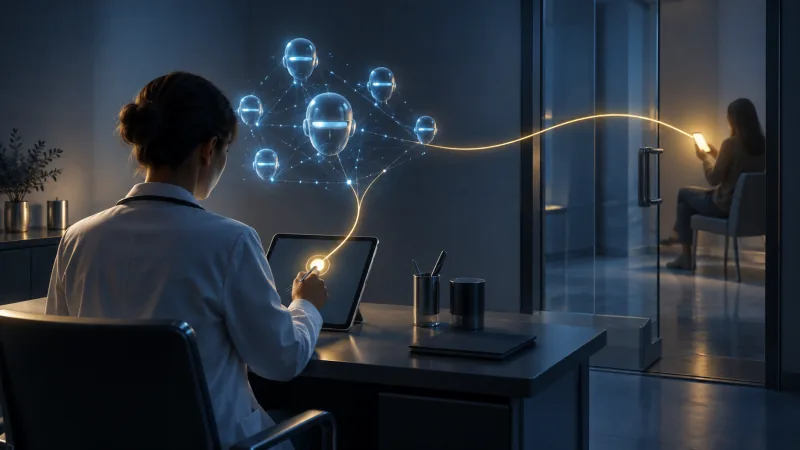
A physician in a white coat taps a stylus on a tablet, lighting a gold circle; a gold line runs through small glowing AI agents to a patient's phone beyond a glass door.

In practice

  1. 09:00What happened · A patient’s new results arrive, six months into the programme
  2. 09:05The system · Staff verify each value against the lab sheet, row by row
  3. 09:20The system · A draft report and programme written from the verified results, the notes and the last report
  4. 11:30A person · The physician edits two sections and signs
  5. 11:31The outcome · Published to the patient’s app and as a PDF, with the retests on the calendar

Today

A longevity report takes a physician hours to assemble from new results, old reports and consultation notes, and a number copied by hand can be copied wrong.

With COUNTERSIGN

09:00 → 11:31 · 2 h 31 min

At 09:00 a patient’s new results arrive, six months into their programme. The staff verify each value against the lab sheet, row by row, and nothing unverified can be used. The command center drafts the new report and programme from the verified results, the physician’s consultation notes and the previous report, with every figure traced to its source, and a guard flags any number it cannot trace. At 11:30 the physician edits two sections and signs. Only then is it published: to the patient’s app, as a PDF, and as retests booked on the calendar.

The principle

AGENTS draftproposeprepare authorisation layer THE WORLD the reportthe patient's appretests THE PHYSICIANapprove · release release proposal release
Agents draft and propose; only a person can release.

03/ 10TRUE SCALE

3D Scanning for Clinicians

A photograph cannot be measured, so a change in skin or body shape is judged by eye from one visit to the next.

What it does

A 3D scanning system for physicians, dermatologists and skin-care specialists. One walk around the patient with an iPhone Pro produces a measurable 3D model at true scale, and scans of the same patient line up over time, so a change is measured rather than guessed. Scans stay in a library each clinic controls, and every measurement goes into a report the clinician signs.

Capabilities

  • Captured with an iPhone Pro in minutes, at true metric scale
  • Scans of the same patient aligned over time, and the change measured
  • Reports with the measurements, signed by the clinician and shared with the patient
  • A library each clinic controls, with access per clinician

In use

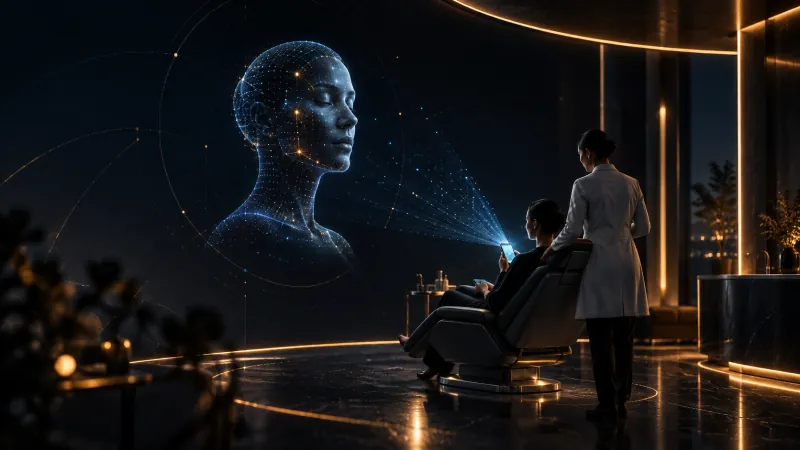
A clinician stands behind a seated patient in a calm clinic while a fan of blue capture points from a phone builds a 3D model of a head and shoulders.

In practice

  1. 10:00A person · A dermatologist scans the patient’s face and neck with an iPhone Pro
  2. 10:04The system · The 3D model reconstructed at true scale and aligned to the scan from March
  3. 10:05The system · The change measured area by area and shown on the model in colour
  4. 10:15A person · The dermatologist reviews it with the patient and signs the report
  5. 10:16The outcome · A record anyone can measure again, in the clinic’s library and on the patient’s phone

Today

A photograph cannot be measured, so a change in skin or body shape is judged by eye from one visit to the next.

With TRUE SCALE

10:00 → 10:16 · 16 min

At 10:00 a dermatologist scans a patient’s face and neck with an iPhone Pro, walking once around the chair. A few minutes later the 3D model is ready at true scale and aligned to the scan taken in March, so the two are compared surface to surface. The change is measured area by area and shown on the model in colour. The dermatologist goes through it with the patient and signs the report. The record goes into the clinic’s library and to the patient’s phone, ready to be measured again at the next visit.

04/ 10SECOND CLOCK

Longevity Passport

A patient’s health lives in PDFs, lab portals and wearables that never meet, so nobody sees the years as one story.

What it does

A patient app for longevity and preventive-medicine programmes. Every result, scan, report and wearable reading in one record over the years; a biological age and pace of ageing recalculated at every draw; a daily summary; an assistant that answers in the patient’s language from their own data; and a vault for every document. Only what the physician has signed reaches the app, and nothing in it diagnoses.

Capabilities

  • Results, scans, reports and wearables in one record over the years
  • Biological age and pace of ageing, recalculated at every draw
  • An assistant that answers from the patient’s own data, in their language
  • Only physician-signed content reaches the app; a vault for every document

In use

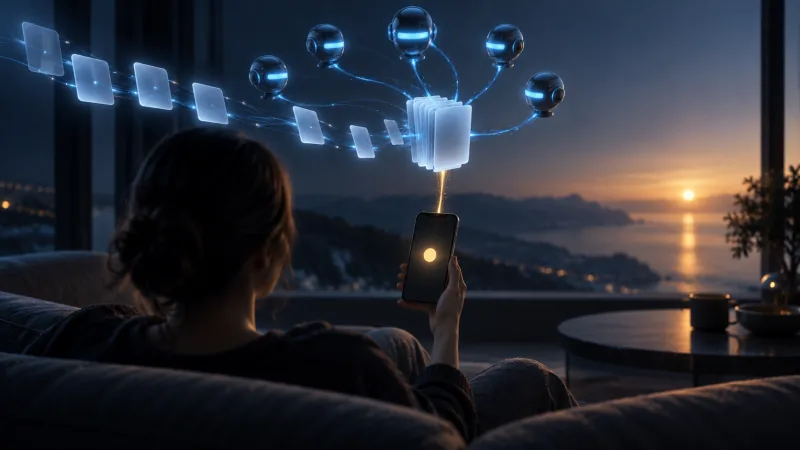
A woman seen from behind on a sofa at dawn holds her phone as small glowing AI agents gather blank glowing cards into one stack and a gold line carries it into the phone.

In practice

  1. 07:30The system · The morning summary: last night’s recovery and today’s programme items
  2. 11:31What happened · The physician signs the new report, and it appears in the app
  3. 11:32The system · Biological age recalculated from the new results; five years of trends updated
  4. 12:10A person · The patient asks the assistant what changed, and books the retest
  5. 12:11The outcome · Five years in one story, and every word in it signed by the physician

Today

A patient’s health lives in PDFs, lab portals and wearables that never meet, so nobody sees the years as one story.

With SECOND CLOCK

07:30 → 12:11 · 4 h 41 min

Six months into a longevity programme, a patient starts the day with a short summary in the app: last night’s recovery from their wearable and the programme items due today. At 11:31 the physician signs the new report in the clinic’s command center, and it appears in the app at that moment, never before. The biological age is recalculated from the new results and five years of trends move with it. At lunch the patient asks the assistant what changed; it answers from their own record, in their own language, sends any question about treatment to the physician, and books the retest the physician asked for.

05/ 10FAIR COPY

Ambient Clinical Notes

Clinicians type through the consultation and finish their notes in the evening, so the patient gets less of their attention.

What it does

With the patient’s agreement, it listens to the consultation, in Greek, English or both at once, and drafts the note, the patient’s letter and any referral, every line linked to the moment in the conversation it came from. The clinician edits and signs; nothing is filed or sent until they do, and the audio is deleted as the clinic’s policy requires.

Capabilities

  • Recorded only with the patient’s agreement, in one language or two at once
  • A draft note, letter and referral, every line linked to its moment in the audio
  • Nothing filed or sent until the clinician edits and signs
  • No diagnosis, orders or treatment suggestions; the audio deleted on sign-off

In use

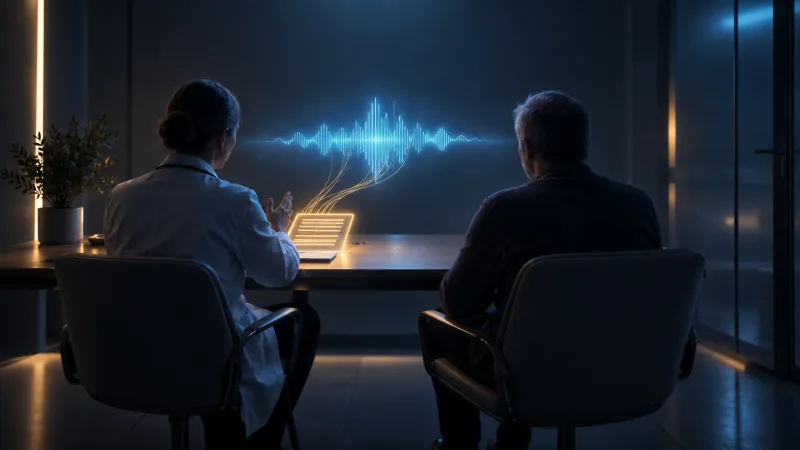
A physician and a patient, seen from behind, sit talking at a desk as a blue sound wave of their conversation floats before them, sending gold threads into a glowing page of lines.

In practice

  1. 10:40What happened · The patient agrees on the room tablet, and the recording starts
  2. 10:58The system · The draft note and letter assembled, every line linked to its moment in the audio
  3. 11:00A person · The physician deletes one sentence and corrects a date
  4. 11:02A person · The physician signs; nothing has left the room before this
  5. 11:03The outcome · The note filed, the letter sent in the patient’s language, the audio deleted

Today

Clinicians type through the consultation and finish their notes in the evening, so the patient gets less of their attention.

With FAIR COPY

10:40 → 11:03 · 23 min

On Tuesday at 10:40 a returning patient moves between Greek and English mid-sentence as she describes the last few months. When the tablet in the room asks whether the visit may be recorded for the note, she taps yes. When the visit ends, the physician’s screen already shows a draft: what the patient reported, what was examined, the plan the physician said aloud, and a letter to the patient in Greek. Clicking any line replays the moment it came from. The physician deletes a sentence that overstates something the patient said, corrects a date and signs. Only then does the note go into the clinic’s record and the letter reach the patient’s app, and the audio is deleted as the clinic’s policy requires. The physician walks into the next consultation with nothing left to write.

06/ 10SAFE PASSAGE

Medical Travel Coordination

People who travel for planned treatment arrive with incomplete records and go home with nobody holding the thread of their care.

What it does

One coordination line, on WhatsApp, the phone and a secure portal in the traveller’s language, gathers their records before any quote and puts them in front of the treating clinician. It then plans the stay around the clinical plan and, after treatment, sends the home doctor a signed summary in their language through a link that expires; every clinical question goes to the treating team.

Capabilities

  • Records gathered through a secure link before any quote, never through the chat
  • The stay planned around the clinical plan: appointments, rest days, room and transfers
  • Consent in the traveller’s language, and a signed summary for the home doctor
  • Check-ins after the return, with every clinical question passed to the treating team

In use

A woman at a rainy city window talks on her phone; a gold line of light runs from it through small glowing AI agents over the sea to a clinician in a coastal clinic.

In practice

  1. Mon 19:10What happened · An enquiry on WhatsApp in the traveller’s language; records requested through a secure link
  2. Tue 09:30A person · The treating clinician reviews the complete file on a video call and decides what to offer
  3. Tue 11:00The system · The stay planned around the clinical plan, with a consent pack in her language
  4. Day 5A person · The clinician signs the summary, and a qualified reviewer checks the translation
  5. Day 12The outcome · Her home doctor opens the signed summary before her first follow-up at home

On Monday at 19:10 a woman in northern Europe writes to a clinic’s WhatsApp, in her own language, about a planned procedure, and starts sending photos of old reports. The coordination line answers in her language and asks her to upload them through a secure link instead, listing exactly what the clinic needs, and follows up the two items still missing. On Tuesday morning the treating clinician reviews the complete file on a video call with her and decides what can be offered. The stay is built around that plan: consultation day, procedure day, two rest days, a check the day before her flight, a room near the clinic and a pickup at the airport, with the consent pack in her language. After treatment the clinician signs a summary, a qualified reviewer checks the translation, and with her permission her home doctor receives a link that expires after thirty days. Check-ins reach her at home in her language, and any question about her recovery goes straight to the treating team.

07/ 10LOOKING GLASS

Aesthetic Consultation Preview

Aesthetic patients agree to treatment against a picture in their head that nobody else can see.

What it does

From the patient’s own 3D scan, the practitioner shows a small set of previews, each held within the range they consider achievable, beside the untouched scan and rotatable in 3D. Every preview is marked as an illustration, and the one the patient chooses is saved with the consent record, so both sides can see later what was discussed.

Capabilities

  • Previews from the patient’s own 3D scan, not from other people’s photographs
  • Held within the range the practitioner sets; the system recommends nothing
  • Every preview marked as an illustration, and never exported for marketing
  • The chosen preview saved with the signed consent

In use

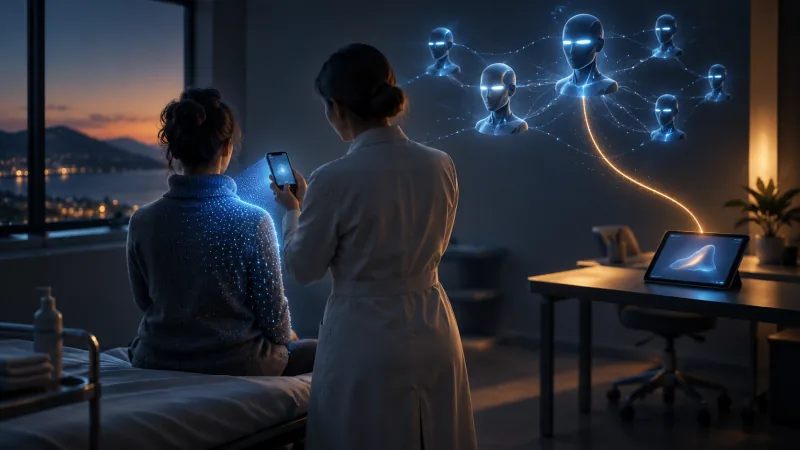
A practitioner holds a phone up to a seated patient in a high-collared sweater, blue points falling across her shoulder, as small glowing AI agents send a gold line to a tablet on the desk.

In practice

  1. 17:30What happened · The patient arrives with photos of other people’s faces
  2. 17:34The system · Her face captured in 3D on an iPhone Pro; the measurable model ready
  3. 17:40A person · The practitioner chooses what to preview and the range she thinks realistic
  4. 17:46The system · Two previews beside the untouched scan, each marked as an illustration
  5. 17:55The outcome · The patient chooses the conservative preview, saved with her signed consent

Today

Aesthetic patients agree to treatment against a picture in their head that nobody else can see.

With LOOKING GLASS

17:30 → 17:55 · 25 min

On Thursday at 17:30 a patient arrives at an aesthetic clinic with three photos of other people’s faces to show what she wants. The practitioner captures her face on an iPhone Pro in under a minute and previews two options, a conservative one and a fuller one, each held to the range she thinks realistic for this face and shown beside the untouched scan. The patient turns the model to see her profile and says the fuller one does not look like her. The practitioner narrows the range, explains what she cannot promise, and saves the conservative preview, marked as an illustration, to the consent record. The patient books for the following week, and the preview sits in her file beside her signed consent.

08/ 10BESPOKE

Made-to-Measure Body Capture

Custom supports and garments still start with plaster, a tape measure and a trip to be measured.

What it does

It captures a limb or torso in 3D on an iPhone or iPad in minutes, at home and without a signal, and turns it into a measured model carrying the circumferences, lengths and volumes the fitter’s form asks for. The orthotist or fitter checks the model and sends it for fabrication, and the scan stays on file so the next fitting starts from a known shape.

Capabilities

  • A limb or torso captured in 3D in minutes, offline
  • Circumferences, lengths and volumes measured the way the fitter’s form asks
  • The fitter checks, adjusts and sends it to the lab
  • The scan kept on file, so the next order starts from a known shape

In use

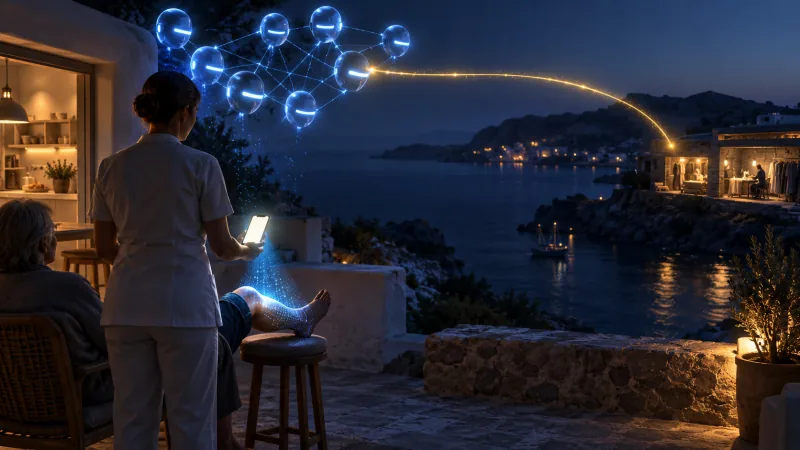
On an island terrace at dusk, a nurse scans a seated patient's lower leg with a phone as small glowing AI agents send a gold line across the bay to a garment workshop.

In practice

  1. Tue 11:00What happened · A made-to-measure garment is needed, and the nearest fitter is a ferry ride away
  2. Tue 11:05The system · The nurse scans the lower leg on an iPhone, offline, and it is measured on the device
  3. Tue 14:30The system · The scan syncs when the signal returns and lands in the fitter’s library
  4. Tue 19:00A person · The fitter moves one landmark and approves the measurements for the lab
  5. Day 9The outcome · The garment arrives by post, the fit is confirmed on a video call, and the scan is kept

On Tuesday at 11:00, in the kitchen of a house on an island with no fitting service, a community nurse scans a patient’s lower leg with an iPhone in about a minute, with no signal. The measured model is ready on the device before she leaves. At 14:30 her phone finds a signal and the scan syncs to the fitter’s library on the mainland. That evening the fitter opens the model, moves one landmark, approves the measurements and sends them to the garment lab. Nine days later the made-to-measure garment arrives by post, and the fitter checks the fit on a video call. The scan stays on file for the next order.

09/ 10OPEN BOOK

Consent & Access Ledger

Patients cannot see who opened their record, and clinics cannot prove who agreed to what.

What it does

One place where each patient sees every access to their record, who, when and for what stated purpose, and grants, time-limits or revokes access per clinic, clinician or document. The same ledger, which can only be added to, holds every procedure consent in the patient’s language: what was explained, the questions asked, each version, the signature and any withdrawal.

Capabilities

  • Every access to the record shown to the patient: who, when and why
  • Access granted, time-limited or revoked per clinic, clinician or document
  • Consents in the patient’s language, versioned and signed
  • Emergency access allowed, always logged and reviewed

In use

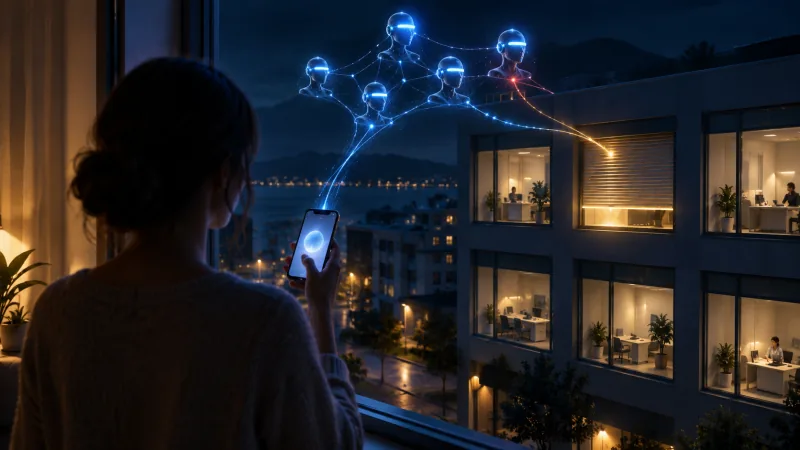
A woman holds a phone at her window at night; threads rise through small glowing AI agents to lit office windows across the street, and a red-gold line reaches one window with its shutter down.

In practice

  1. Fri 22:05What happened · The patient is told her record was opened by a clinic she visited once
  2. Fri 22:07A person · She sees who opened it, when and why, and flags that she does not recognise it
  3. Mon 09:15A person · The clinic’s data-protection lead follows the trail and corrects a role set too wide
  4. Mon 10:00The system · The explanation sent to the patient and sealed onto the ledger
  5. Mon 10:12The outcome · She withdraws that clinic’s access and gives her new physician 90 days to read her results

On Friday at 22:05 a patient gets a WhatsApp notice that her record has just been opened by a clinic she visited once, two years ago. She opens the ledger in her app: the access came from a front-desk account, with the stated purpose “billing”. She taps “I don’t recognise this”. On Monday morning the clinic’s data-protection lead opens the query, follows the trail and finds a role that was set too wide after a staff change. She corrects it and replies to the patient explaining what happened. The patient then withdraws that clinic’s access and gives her new physician read access to her results for ninety days. Every step, the reply included, is on the ledger.

10/ 10SHORTLIST

Trial Pre-Screening

Studies stall for lack of participants, while eligible people sit unseen in their own clinic’s records.

What it does

It reads a study’s criteria and then the clinic’s records, inside the clinic’s own systems, and produces a checklist for each candidate in which every tick links to the line behind it and every gap is marked unknown, never guessed. The coordinator and investigator decide, the patient’s own clinician makes first contact, and nothing about a patient leaves the clinic before they consent.

Capabilities

  • Criteria read against the clinic’s records, inside its own systems
  • Every tick linked to its evidence; every gap marked unknown, never guessed
  • The coordinator and investigator decide who is eligible
  • The patient’s own clinician makes first contact; nothing leaves before consent

In use

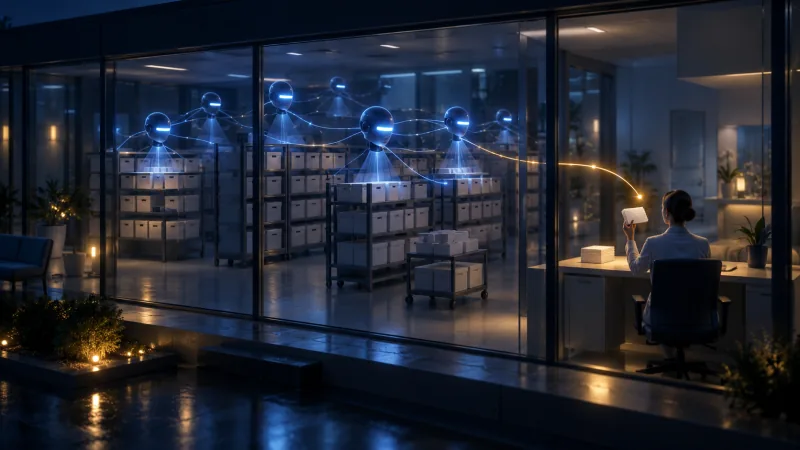
Inside a glass clinic at night, small glowing AI agents hover over shelves of plain record boxes, and a gold line reaches a coordinator at her desk holding up a stack of blank cards.

In practice

  1. Sun 23:00The system · The study’s criteria read, and the clinic’s records checked inside its own systems
  2. Mon 08:30The system · The coordinator’s queue fills with evidence-linked checklists; unknowns flagged
  3. Mon 10:00A person · The coordinator removes two candidates and the investigator confirms three
  4. Next weeksA person · Each patient’s own physician mentions the study at a routine visit
  5. Day 12The outcome · One patient consents with the study team; nothing about her left the clinic before

On Monday at 08:30 a multi-specialty clinic that has agreed to host a new study with fourteen criteria finds a short list in the coordinator’s queue. Overnight the records of patients seen in the last two years were read against the criteria, inside the clinic’s own systems. Each candidate comes with a checklist, every tick linked to the sentence in the record behind it, and every missing fact marked unknown. The coordinator removes two candidates whose key result was unknown and sends four to the investigator, who confirms three. Over the next fortnight each patient’s own physician mentions the study at a routine visit. One patient wants to hear more and signs the consent with the study team; until that signature, nothing about her had left the clinic.

By the numbers

10
named solutions
9
running systems behind them
7
capability lines applied
9
other industries sharing these systems

Counted from this site's own pages at build time. Nothing here is a claim.

Applied capabilities.

The divisions this industry draws on, and what they do here.

VANTA

3D skin & body capture

True-scale 3D models from an iPhone Pro, aligned over time so a change is measured, not guessed.

CHIRON

Longitudinal health intelligence

Results, scans and wearables resolved into one record per patient, published only once a physician has signed it.

ATLAS

Agents at the front desk

A receptionist on the phone and WhatsApp in the patient’s own language, handing to staff with the whole thread.

AEGIS

Consent & access you can prove

Every access to a record visible to the patient, and every consent versioned, signed and kept.

FORGE

Applied Software Engineering

Operations cockpits, client portals, admin consoles and release pipelines. The practice that turns a prototype into something a business can stand on.

CONCORD

Allocation & Matching

Real-time matching and dispatch. Pairing supply with demand across constraints that move faster than a human dispatcher can hold in their head.

PRISM

Generative & Creative Systems

Creative production tools where the output has to satisfy a paying client — generation, precision editing and a paint engine built on Metal.

Put this to work in your operation.

Tell us what you are trying to achieve. We will tell you, honestly, what we can do.

Start a conversationAll industries

Analytics choices