
Contact

Automotive

The fleet is the sensor.

Every connected vehicle is a node in a distributed nervous system. We turn that into intelligence.

We engineer the road before the wheels reach it.

Mobility is a network now.

A car is no longer a thing that moves. It is a sensor, a decision point and a data source, travelling through a city that is itself becoming instrumented.

We build the layer that fuses millions of those signals into live, actionable intelligence — routing, dispatch, safety and autonomy, all in real time.

How the nine work together

A fleet vehicle’s working life, from the first shift to the handback.

Each solution acts where the fleet needs it. Drivers, dispatchers and service teams make the calls that matter.

  1. Behind the wheel

    The right person, handed control in time

  2. On the road

    Every job matched, every position true

  3. Off the road

    Breakdowns and the night at the depot

  4. In for service

    Every call answered, every recall reached

  5. Handed back

    Condition shown, not argued

Solutions for automotive.9 named solutions, each shown in use below.

What happenedThe system actsA person acts or decidesThe outcome

01/ 09ONE DRIVER

Driver Identity & Access

A verified driver can lend an account to someone nobody has checked.

What it does

Sign-in for a fleet’s drivers built so that the account and the person stay the same: multi-factor sign-in on an approved device, a fresh check at the start of each shift, and a lock when the same account appears somewhere it cannot plausibly be. Every sign-in and every lock is on the record.

Capabilities

  • Multi-factor sign-in on an approved device
  • A fresh check at the start of every shift
  • Locked when the account appears somewhere it cannot plausibly be
  • Every sign-in and lock on the record

In use
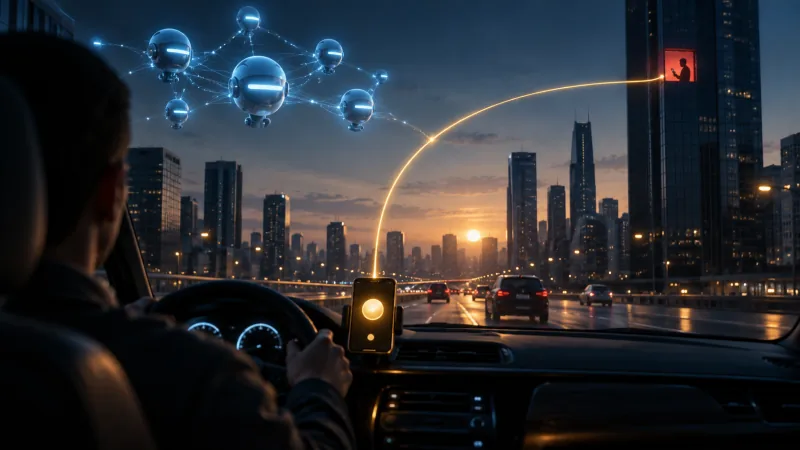
A driver seen from behind heads into a city at dawn, phone glowing gold on the dashboard, as small glowing AI agents float and a gold line arcs to a distant red-lit tower window.

In practice

  1. 06:00The system · Shift start: approved phone, second factor, signed in
  2. 06:40What happened · The same account tries to sign in on an unknown phone across the city
  3. 06:40The system · Refused and flagged: one account cannot be in two places
  4. 06:45A person · The fleet manager calls the driver and blocks the unknown phone for good
  5. 06:46The outcome · The account stays with the person who was checked

Today

A verified driver can lend an account to someone nobody has checked.

With ONE DRIVER

06:00 → 06:46 · 46 min

A driver starts a shift at 06:00 on the phone the fleet approved, with a second factor. At 06:40 the same account tries to sign in on an unknown phone across the city. The attempt is refused and flagged, and the driver’s own session keeps working. The fleet manager calls the driver, who never shared the account, and the unknown phone is blocked for good.

Built from
02/ 09HANDOVER

Assisted & Autonomous Guidance

The dangerous part of assisted driving is the moment the system knows less than it thinks.

What it does

A guidance layer built around that transition: continuous self-assessment of confidence, degradation that announces itself early, and a hand-back to the driver with enough warning to be useful rather than an alarm.

Capabilities

  • Continuous self-assessment of confidence
  • Degradation announced early, not at the boundary
  • A hand-back with enough warning to be useful

In use

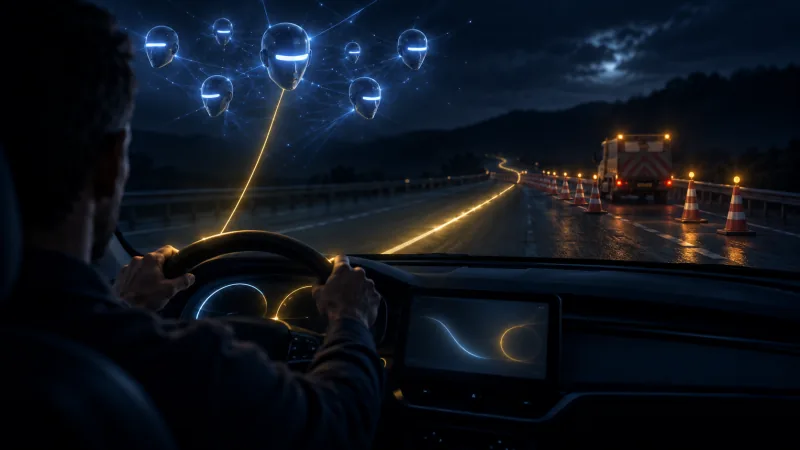
A driver at night grips the wheel as small glowing AI agents above the motorway send a gold line to their hands. Ahead, a gold lane marking leads toward roadworks cones and a works truck.

In practice

  1. MotorwayThe system · Assisted driving holds the lane with high confidence
  2. RoadworksWhat happened · Lane markings fade and confidence starts to fall
  3. 12 s beforeThe system · The driver told early: take over in twelve seconds
  4. 4 s beforeA person · The driver takes the wheel before the boundary
  5. BoundaryThe outcome · Control handed back with time to spare, not as an alarm

On the motorway, assisted driving holds its lane with high confidence. Ahead, roadworks begin and the markings fade; the system’s confidence falls, and it shows it. Twelve seconds before the boundary it tells the driver to take over, early and calmly, before any alarm. The driver takes the wheel with four seconds to spare, and control is handed back before the system knows less than it thinks.

The principle

markings fade true track honest estimate · error shown a confident wrong position driver takes over along the route
An honest error bound, shown as it grows, instead of a confident wrong position.

Built from

03/ 09DISPATCH ZERO

Sub-Second Allocation

An allocation that arrives late answers a question the fleet has already moved past.

What it does

An allocation engine that solves vehicle to job against every constraint that matters at once — position, hours, vehicle class, customer window, price floor — and delivers the answer fast enough that it is still true when it arrives.

Capabilities

  • Position, hours, vehicle class, customer window and price floor solved together
  • Fast enough that the answer is still true on arrival
  • Runs continuously against a working fleet
  • Measured by how rarely a dispatcher overrides it

In use

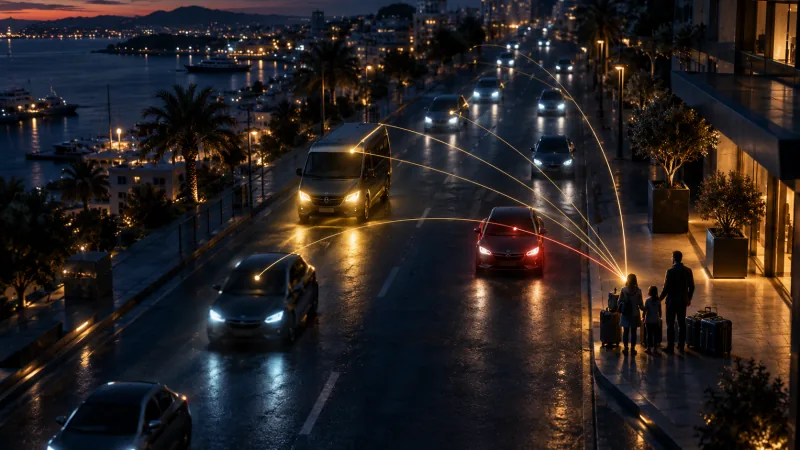
A family with luggage waits at the kerb of a wet seaside street at dusk; gold threads of light reach them from a van and several approaching cars, while the nearest car's thread glows red.

In practice

  1. 17:02What happened · A booking lands: airport, 17:30, six passengers with luggage
  2. 17:02The system · Every vehicle scored on position, hours, class and the customer’s window
  3. 17:02The system · The nearest free car is too small; a van four minutes further is chosen
  4. 17:03A person · The dispatcher sees the choice and the reason, and lets it stand
  5. 17:28The outcome · The van arrives inside the window; nothing was overridden

Today

An allocation that arrives late answers a question the fleet has already moved past.

With DISPATCH ZERO

17:02 → 17:28 · 26 min

At 17:02 a booking lands: the airport at 17:30, six passengers with luggage. Every free vehicle is scored at once on position, hours left, class and the customer’s window. The nearest car has four seats, so a van four minutes further away is chosen. At 17:03 the dispatcher sees the choice and the reason, and lets it stand; the van arrives at 17:28, inside the window. The honest measure of quality is how rarely a dispatcher overrides it.

04/ 09ROADSTATE

Fleet Positioning & Movement

Signals that are individually unreliable produce a picture nobody can use to settle a dispute.

What it does

Every vehicle position, heading and history fused from unreliable signals into a picture accurate enough to settle a dispute, with geofences that fire when they should and routing computed against the road as it is today.

Capabilities

  • Position, heading and history fused from unreliable signals
  • Geofences that fire when they should and not when they should not
  • Routing against the road as it is today, not as the map remembers it

In use

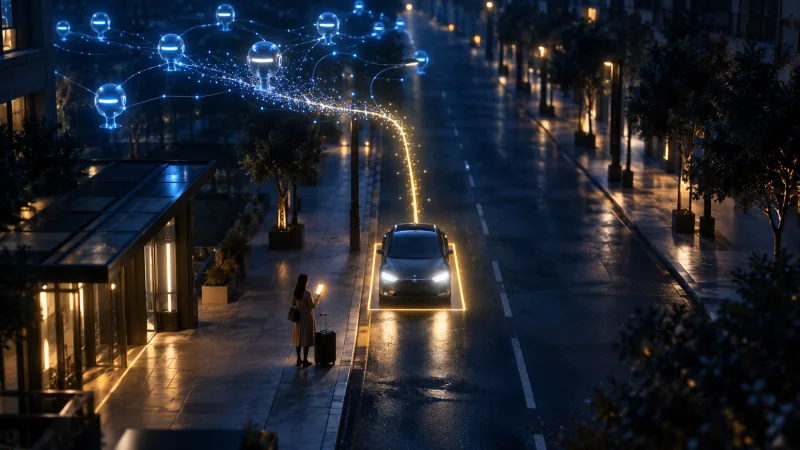
A car waits at a kerb at night inside a gold rectangle as small glowing AI agents gather blue sparks into one gold trace along its lane, while a woman nearby holds a glowing phone.

In practice

  1. LiveThe system · Every vehicle’s position fused from GPS, the phone and the road network
  2. 10:14What happened · A customer disputes a pickup: the car never came
  3. 10:15The system · The trace shows the car at the kerb from 10:02, inside the geofence
  4. 10:16A person · The operator shares the trace with the customer
  5. 10:20The outcome · Settled with the record, not with an argument

At 10:14 a customer disputes a pickup: the car never came. The operator opens the trace. Position fused from the car’s GPS, the driver’s phone and the road network puts the car at the kerb from 10:02, inside the pickup geofence, with the driver’s call at 10:05. At 10:16 the operator shares the trace with the customer, and by 10:20 the dispute is settled with the record, not with an argument.

05/ 09HARD SHOULDER

Roadside Assistance Dispatch

A breakdown call starts with the hardest question: where exactly are you?

What it does

Dispatch for roadside assistance. The stranded driver gets a link that captures their exact position, the nearest suitable truck is matched on skills and equipment, and the driver sees it coming. If the car cannot be fixed on the spot, the tow and the onward journey are booked in the same flow.

Capabilities

  • The exact position captured by a link, not described over the phone
  • The nearest suitable truck matched on skills and equipment
  • The driver sees the truck coming, with an honest arrival time
  • Tow and onward journey booked in the same flow when a fix fails

In use

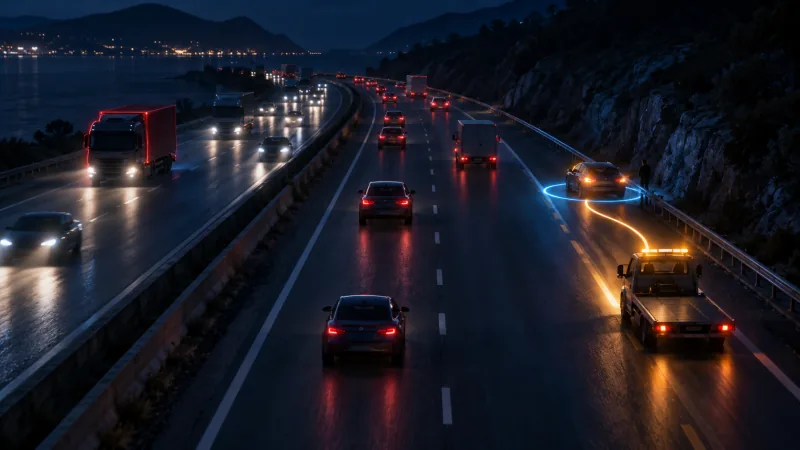
A broken-down car sits on a night motorway's hard shoulder, ringed in blue light, as a recovery truck with amber beacons follows a gold route up to it; oncoming traffic fills the far carriageway.

In practice

  1. 22:10What happened · A driver breaks down at night and cannot say where
  2. 22:11The system · A link captures the position, on the right carriageway
  3. 22:11The system · The nearest truck has no charger for an electric car; the next is sent
  4. 22:35A person · The patrol arrives and decides the car must be towed
  5. 22:40The outcome · Tow and a taxi home booked before the patrol leaves

Today

A breakdown call starts with the hardest question: where exactly are you?

With HARD SHOULDER

22:10 → 22:40 · 30 min

A driver breaks down on a motorway at night and cannot say where. A link captures the position to within a few metres, on the right carriageway. The nearest truck carries no charger for an electric car, so the next one is sent. The driver watches it arrive in twenty-four minutes; the fault cannot be fixed on the spot, so a tow and a taxi home are booked before the patrol leaves.

06/ 09OVERNIGHT

Depot Charging Orchestration

An electric fleet that all plugs in at six drives up the peak and still leaves some vehicles short for the morning.

What it does

Charging planned across the night for every vehicle in a depot: each one charged to what its first job needs, by the time it leaves, without the site ever drawing more than its grid connection allows. When a vehicle comes in late or a job changes, the plan re-solves.

Capabilities

  • Every vehicle charged to what its first job needs
  • The site kept under its grid connection all night
  • Charging moved into the cheaper hours where the schedule allows
  • A late arrival or a changed job re-solves the plan

In use

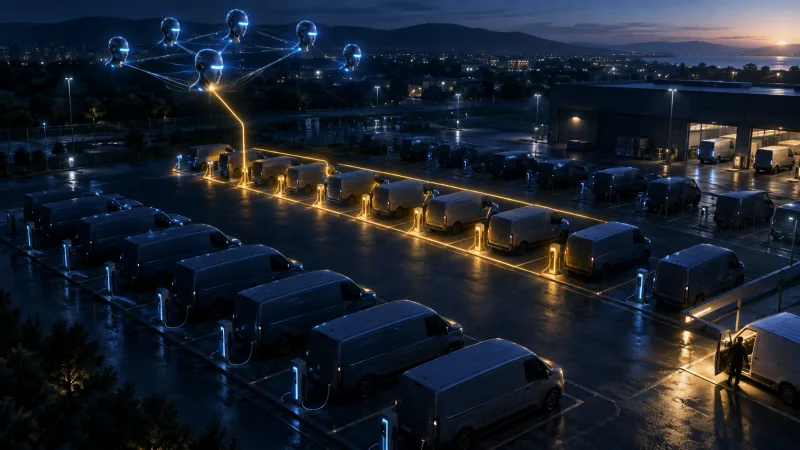
Rows of vans sit plugged into chargers at a night depot; small glowing AI agents send a gold line along one lit row while others stay dim, and a driver climbs into a van.

In practice

  1. 19:00What happened · Forty vans back at the depot; the connection cannot charge them all at once
  2. 19:01The system · Charging staggered through the night, earliest routes first
  3. 23:10The system · Van 17 reassigned to a longer route: its target raised, two vans moved later
  4. 23:12A person · The night supervisor sees the change and leaves it
  5. 05:30The outcome · Every van ready for its first job; the peak never passed the limit

Today

An electric fleet that all plugs in at six drives up the peak and still leaves some vehicles short for the morning.

With OVERNIGHT

19:00 → 05:30 · 10 h 30 min

Forty vans return to a depot between 18:00 and 19:00. Plugged in on arrival they would all draw at once and breach the connection. The plan staggers them through the night, filling the vans with the earliest routes first. At 23:10 van 17 is reassigned to a longer morning route; the plan raises its target and moves two others later. At 05:30 every van has what its first job needs, and the peak never passed the limit.

07/ 09OPEN LINE

Service Booking Agent

A service department that cannot answer the phone loses the booking to whoever does.

What it does

A voice and message agent that answers every call to the service department, books the slot against the workshop’s real capacity, arranges a courtesy car or a lift, and reminds the customer before the appointment. Questions about faults, safety, warranty or cost go to a service advisor.

Capabilities

  • Every call answered, at any hour
  • Slots booked against the workshop’s real capacity
  • Courtesy car or a lift arranged with the booking
  • Faults, safety, warranty and cost handed to an advisor

In use

At night a customer on the phone stands by a car with a red dashboard light; small glowing AI agents overhead send a gold line to a workshop where a courtesy car lights up.

In practice

  1. 19:40What happened · A customer calls after hours about a warning light
  2. 19:41The system · The first diagnostic slot booked, 08:30, with a courtesy car
  3. 19:42What happened · The customer asks whether it is safe to drive
  4. 19:50A person · The on-call advisor calls back and advises
  5. 08:30The outcome · The car in the workshop on time; the call was never missed

Today

A service department that cannot answer the phone loses the booking to whoever does.

With OPEN LINE

19:40 → 08:30 · 12 h 50 min

A customer calls at 19:40, after the service desk has closed, because a warning light has come on. The agent books the first free diagnostic slot, 08:30 the next morning, and a courtesy car for the day. When the customer asks whether it is safe to drive, the agent does not guess: it passes the question to the on-call advisor, who calls back within ten minutes.

08/ 09LAST OWNER

Recall Outreach Agent

A recall notice goes to whoever owned the car when it was sold, and older cars are rarely fixed.

What it does

Outreach for open recalls that works through a dealer’s own service records to reach the person driving the car today: by message, by phone and by letter, in their language, with the repair, the parts and a courtesy car booked in one step. Owners who cannot be reached are listed for the service team with the reason.

Capabilities

  • Open recalls matched to the dealer’s own service records
  • Owners reached by message, phone and letter, in their language
  • Repair, parts and courtesy car booked in one step
  • Owners who cannot be reached listed for the service team

In use

A man at his lit front door, an older sedan in the driveway, holds a phone catching a gold line of light sent across town by small glowing AI agents over a dealership.

In practice

  1. Day 1What happened · A recall covers 1,200 vehicles sold by the dealer, many of them older
  2. Day 1The system · Owners found through the service records, not the original sale
  3. Day 2The system · Messages, calls and letters in each owner’s language; repairs booked with parts
  4. Week 2A person · The service team works the list of owners who could not be reached
  5. Week 3The outcome · Repairs booked for the owners reached; no owner left without a reason on file

A recall covers 1,200 vehicles sold by one dealer, many of them eight or more years old. The agent works through the dealer’s service records rather than the original sale, messages the owners it can reach and calls those who do not reply. Repairs are booked with the parts ordered, and every owner it could not reach is on the service team’s list with the reason.

09/ 09FAIR RETURN

Vehicle Condition at Handover

Damage found at a return is only fair if it can be shown to be new.

What it does

Condition capture at every handover of a rental, a fleet car or a used car at sale: the same passes under the same conditions, compared with the last capture, so what is new is measured rather than guessed. A person decides any charge, and the customer sees the same evidence.

Capabilities

  • The same capture at every handover, under the same conditions
  • Compared with the last capture, so only new damage is flagged
  • Reflections and dirt set aside before anything is called damage
  • A person decides any charge; the customer sees the same evidence

In use

A returned car is wrapped in a fine blue scan of light, one short scratch on its side glowing red, as a customer and a desk agent holding a tablet look at it together.

In practice

  1. PickupThe system · The car captured at pickup: every panel, the same passes
  2. ReturnThe system · Captured again and compared, panel by panel
  3. ReturnThe system · A mark on the bonnet set aside: there at pickup, a reflection, not a dent
  4. DeskA person · The agent reviews the one new scratch with the customer
  5. DeskThe outcome · Any charge decided on evidence both can see

A car comes back after a week’s rental and is captured again. A mark on the bonnet is flagged, then set aside: it was there at pickup, and a second angle shows a reflection, not a dent. A 4 cm scratch on the rear door is new. The desk agent reviews it with the customer on the same screen and decides the charge on evidence both of them can see.

By the numbers

9
named solutions
9
running systems behind them
6
capability lines applied
9
other industries sharing these systems

Counted from this site's own pages at build time. Nothing here is a claim.

Applied capabilities.

The divisions this industry draws on, and what they do here.

ROBOTRONIX

Vehicle guidance & autonomy

Guidance, navigation and control for autonomous and assisted driving — robust where the map runs out.

MERIDIAN

Fleet positioning

High-precision positioning and movement intelligence across an entire fleet, continuously.

CONCORD

Real-time dispatch

Constraint-aware matching and dispatch that pairs vehicles to demand in milliseconds.

AEGIS

Trust, Access & Audit Fabric

Row-level authorisation, multi-factor authentication, device approval, tiered access and an append-only audit trail. The sign-in on this site is the product.

ATLAS

Agentic AI Systems

Multi-agent systems that plan, call tools and run operational workflows under human command. Every decision logged, attributable and reversible.

VANTA

Spatial Capture & Reconstruction

LiDAR and photogrammetric capture on commodity hardware, reconstructed into measurable, navigable models — not decorative point clouds.

Put this to work in your operation.

Tell us what you are trying to achieve. We will tell you, honestly, what we can do.

Start a conversationAll industries

Analytics choices